
A road can look perfect on the day it opens. Five or ten years later, cracks, rust stains and patch repairs start to show.
Most of the time, the culprit is the same: steel corroding inside the concrete.
That is why more road contractors and engineers are asking whether GFRP rebar in RCC pavements is a practical alternative. The answer is yes, in the right conditions. But it is not a simple swap.
This guide covers what actually changes for a contractor, from design and placement to concreting and quality checks. It also includes MRG’s own RCC road experience in Ahmedabad.
Can GFRP Rebar Be Used in RCC Pavements?
Yes. GFRP reinforcement has been studied and used in concrete pavements.
The U.S. Federal Highway Administration published research on continuously reinforced concrete pavements using GFRP rebars. It looked at pavement stresses, design factors and workable pavement designs.
There is also field evidence. A published case study followed a 306 m section of GFRP-reinforced continuously reinforced pavement on Highway 40 West in Montreal. After six years of inspection, its crack behavior was competitive with a steel-reinforced section.
A more recent 2025 field study tested a jointed reinforced concrete pavement with GFRP bars under vehicle loads.
These results show the idea is credible. They do not guarantee that every pavement will perform the same way. Suitability depends on the design, traffic loading, exposure conditions, applicable standards and project requirements.
Why Use GFRP Rebar in Concrete Roads?
Four properties matter most on a road project.
Corrosion Resistance
Steel rusts. As it rusts, it expands, and that pushes the concrete apart from inside. The result is cracking, spalling and repair cost.
GFRP rebar does not corrode the way steel does. That makes it attractive for roads exposed to water, de-icing salts, monsoon flooding or aggressive soils.
It is not immortal, though. GFRP has its own durability considerations, so the bar should be chosen for the exposure environment and the applicable specification.
Lightweight Handling
GFRP bars weigh far less than steel bars of similar size. Crews can carry, lift and position them faster, which helps on long pavement runs.
Lighter does not mean careless. Bars still need proper support and fixing.
Nonmagnetic Properties
GFRP is nonmagnetic. This matters where electromagnetic interference is a concern, such as near sensitive equipment or signalling installations.
High Tensile Strength
MRG’s GFRP rebar has a tensile strength of over 1000 MPa, compared with roughly 500 to 600 MPa for steel. That strength is only useful when the design accounts for how GFRP behaves, which we cover next.
Does GFRP Replace Steel Bar for Bar?
No. This is the biggest misconception on site.
The American Concrete Institute’s FRP guidance (ACI 440.1R) explains that FRP behaves differently from steel. It is anisotropic, it does not yield, and it stays elastic until failure.
In practice, this means you cannot swap a 12 mm steel bar for a 12 mm GFRP bar and call it done. The pavement should be designed using the applicable FRP design guidance and the project’s requirements.
Do not change diameter or spacing on site without approval from the design engineer. If you want the wider comparison, read our GFRP rebar vs steel rebar guide.
GFRP Rebar vs Steel Rebar in RCC Pavements: What Changes on Site?
Not everything changes. But a few things matter a lot.
| Construction Stage | Steel Rebar | GFRP Rebar |
| Handling | Heavier | Lightweight |
| Corrosion | Susceptible | Noncorrosive |
| Cutting | Conventional steel cutting tools | Suitable composite cutting tools |
| Bending | Can generally be bent on site | Do not assume field bending is possible; use manufacturer-approved bent bars |
| Placement | Conventional practice | Follow GFRP-specific handling and placement guidance |
| Design | Steel-based design | FRP-specific design considerations |
| Magnetic environments | Conductive and magnetic | Nonmagnetic |
Let’s look at the four areas that affect crews most.
Design
The drawings should specify GFRP by bar type, diameter and layout. Treat them as the source of truth, not steel habits.
Handling and Cutting
Steel cutters and shears can crush a composite bar. Use suitable tools and control dust. We cover this in detail in our guide on how to cut fiberglass rebar.
Placement
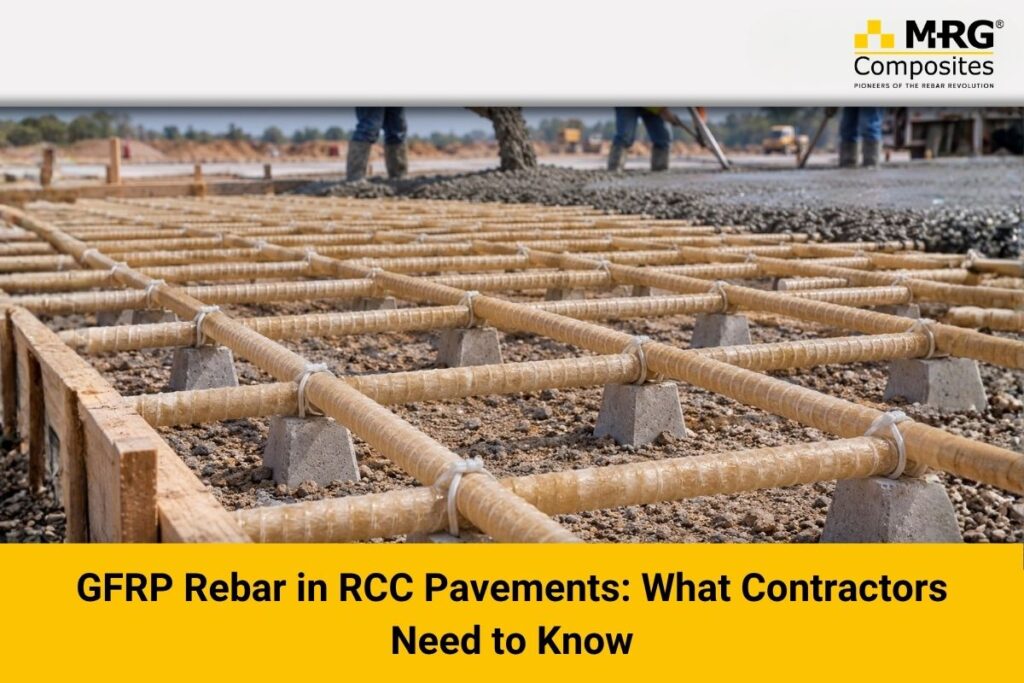
Correct cover, elevation and support are critical. Use proper chairs and secure the bars so they do not shift or float during concreting.
Concrete Pouring
Because GFRP is light, bars can move more easily under the weight of wet concrete and the movement of crews. Secure them well and check position during and after placement.
Where Can GFRP Rebar Be Used in RCC Pavements?
GFRP may be considered where its corrosion resistance, nonmagnetic properties and other characteristics fit the design and exposure requirements.
Typical candidates include:
- Urban RCC roads
- Industrial roads and yards
- Highway pavements where designed and specified
- Bridge approaches
- Parking areas
- Heavy-traffic concrete pavements
- Coastal and waterlogged areas
- Pavements where electromagnetic properties matter
It is not automatically the right choice for every road. For a broader look at road use, see our complete guide to GFRP rebar for road construction.
How Is GFRP Rebar Installed in an RCC Road?
The sequence looks familiar to any road crew. The details are what differ.
- Review the drawings and datasheet. Confirm bar type, diameter, spacing and layout.
- Prepare the sub-base. Get the base level and clean before placing reinforcement.
- Set out the layout. Mark bar positions as shown on the drawings.
- Cut where required. Use suitable composite cutting tools and dust control.
- Place bars on proper supports. Maintain the specified cover and elevation.
- Fix bars securely. Use appropriate ties so bars stay in position.
- Inspect before concreting. Use the checklist below.
- Place and finish concrete. Follow project requirements, and avoid stepping or dragging equipment on bars.
Where shaped bars are needed, use factory-made bent GFRP rebar rather than trying to bend straight bars on site.
What Contractors Should Check Before Concrete Pouring
This is the checklist worth taking to site.
Reinforcement
- [ ] Correct bar type, diameter and quantity
- [ ] Correct spacing and layout
- [ ] Approved drawings and specification on hand
Positioning
- [ ] Correct cover and elevation
- [ ] Proper supports and chairs in place
- [ ] Bars secured with no major displacement
Bar condition
- [ ] No obvious damage or excessive crushing
- [ ] No unauthorized field bending
- [ ] Cut ends handled appropriately
During concreting
- [ ] Reinforcement stays in position
- [ ] Workers avoid damaging bars
- [ ] Vibration and finishing follow project requirements
Common Mistakes to Avoid When Using GFRP Rebar in RCC Pavements
Treating GFRP exactly like steel. The materials behave differently, so the design and handling must too.
Changing bar spacing without approval. Reinforcement layout is an engineering decision, not a site improvisation.
Bending straight bars on site. Use manufacturer-approved bent bars where shapes are required.
Ignoring cover and position. Correct placement matters as much with GFRP as with steel.
Using the wrong cutting tools. Crushed ends and frayed fibers usually trace back to tool choice.
Assuming light means low care. Lightweight bars still need proper handling and support.
Buying without checking documents. Review datasheets and test reports 1st. Our GFRP rebar quality checklist lists ten things to verify before you buy.
GFRP Rebar in an RCC Road Project: MRG’s Ahmedabad Experience
MRG partnered with AAJ BUILDCON on an urban road in Ahmedabad reinforced with GFRP rebar.
The project had real constraints. Heavy traffic, environmental conditions, monsoon flooding, tight timelines and budget pressure all shaped the decision.
GFRP suited those conditions because corrosion from water exposure was a genuine concern. You can read the full story in our RCC road construction Ahmedabad case study.
This project provides a real-world example of how GFRP was specified and implemented on a live urban road, demonstrating its practical application in road infrastructure.
What to Check Before Buying GFRP Rebar for a Road Project
Before you commit, ask for:
- Project design requirements and pavement loading
- Environmental exposure details
- Required bar diameters and shapes
- Applicable standards and specifications
- Product technical datasheet
- Tensile and bond property data
- Durability information
- Quality and testing documentation
- Manufacturer experience and installation guidance
- Availability of required bar sizes and shapes
MRG is India’s 1st BIS License holder for GFRP rebar. It is also ISO 9001:2015 and ASTM certified, with bars available from 3 mm to 22 mm and more than 5000 projects delivered over 18 years.
Final Takeaway
GFRP rebar in RCC pavements is not a shortcut. It is a different material that rewards the contractors who understand it.
Design it properly. Cut it with the right tools. Place it accurately and check it before every pour. Do that, and you can build roads that are far less exposed to the rust that shortens the life of so many pavements.
Working on a road project and weighing your options? Talk to the team at MRG Composites for technical guidance and a quote, or read our GFRP bar price guide to plan your budget.