
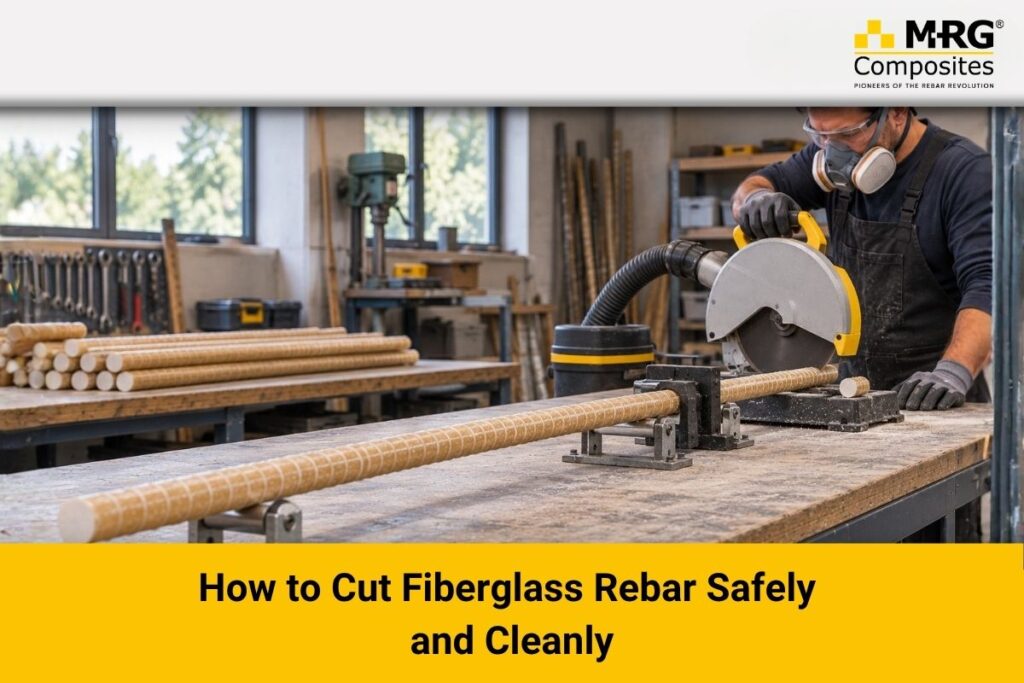
You have a bundle of GFRP bars on site and a cutting list in your hand. Your 1st instinct is to grab the bolt cutters, because that is what works on steel.
Stop there for a second.
Fiberglass rebar behaves very differently from steel. Cut it the wrong way and you get crushed ends, frayed fibers and a cloud of fine dust. Cut it the right way and you get a clean, square end that is ready to install.
This guide shows you how to cut fiberglass rebar with the right tool, less dust and a result you can actually inspect. It covers small field adjustments and large batches alike.
Can Fiberglass Rebar Be Cut on Site?
Yes. Contractors cut GFRP rebar on site every day to fit lengths, corners and openings.
The bars are lightweight and easy to handle. That makes site cutting practical, as long as you plan for dust control and use a suitable tool.
Always check the manufacturer’s guidance for your specific bar before you start. Cutting results can vary with bar diameter, product construction, blade and cutting speed.
What Happens When You Cut GFRP Rebar?
GFRP is made of glass fibers held together by a polymer resin. It is not a solid piece of metal.
When you cut it, you are slicing through thousands of glass fibers and the resin around them. That process creates fine dust made of glass and resin particles.
The tool you choose decides how the end turns out. An abrasive or toothed tool cuts through the fibers. A shearing tool squeezes them until they give way, which can leave a crushed or uneven end.
That is why cutting GFRP rebar is a tool-selection question 1st and a technique question second.
Why GFRP Rebar Should Not Be Cut Like Steel Rebar
Steel rebar is metallic and ductile. It bends and yields under force, so shear cutters and bolt cutters work well on it.
GFRP rebar is a composite. It does not deform the same way, so force applied through a shear blade can crush the section instead of cleanly parting it.
Contractors should not carry steel habits over to composite reinforcement. Excessive force, unsuitable blades and rough handling are the usual causes of poor cuts.
If you want the broader picture of how the two materials differ, read our guide on GFRP rebar vs steel rebar.
What Tools Can You Use to Cut Fiberglass Rebar?
There is no single tool that wins on every job. Each option has strengths and trade-offs.
Diamond Blade
A diamond blade on an angle grinder or cut-off saw is a common choice for site work. It cuts through glass fibers cleanly when used with steady, light pressure.
The trade-off is dust. Dry cutting with a diamond blade throws a lot of fine particles, so pair it with extraction and proper respiratory protection.
Abrasive Cut-Off Wheel
Abrasive wheels are easy to find and work well for general field cutting. They can give a good result on many bar sizes.
They also produce plenty of dust, and wheel suitability matters. Use a wheel rated for the tool and the material, and replace worn wheels.
Carbide-Tooth Saw
Carbide-tooth blades suit smaller or occasional jobs. Results depend heavily on setup and blade condition.
Expect moderate dust and some blade wear, since glass fibers are abrasive.
Reciprocating Saw
A reciprocating saw is handy for quick field adjustments where you cannot bring the bar to a workstation. It can generate less airborne dust than a grinder.
Bar movement and vibration can affect the finish, so clamp the bar firmly. Use a blade suited to abrasive composites.
Band Saw
A band saw gives controlled, repeatable cuts and is a strong option for a shop or yard setup. Dust can be lower and the cut tends to stay square.
It is less portable, so it works best when bars come to the saw rather than the other way around.
Which GFRP Rebar Cutting Method Should You Choose?
Here is a quick comparison. Treat it as a starting point, not a rulebook.
| Cutting Method | Cut Quality | Dust Potential | Best Use | Main Consideration |
| Diamond blade | Clean and controlled when used correctly | Higher without dust control | General site cutting | Dust management |
| Abrasive cut-off wheel | Good | Higher | General field cutting | Wheel and tool suitability |
| Carbide-tooth saw | Depends on setup | Moderate | Small or occasional work | Blade wear |
| Reciprocating saw | Moderate | Potentially lower | Field adjustments | Speed and cut finish |
| Band saw | Good | Potentially lower | Controlled shop cutting | Less portable |
| Bolt cutters / shears | May crush the composite | Low | Generally not preferred | End damage and crushing |
Pick based on your bar diameter, your job size and whether you can control dust at the cutting point.
How to Cut Fiberglass Rebar Step by Step
Follow this workflow whether you are making three cuts or three hundred.
Before cutting
- Confirm the required length and check the bar diameter.
- Review the manufacturer’s instructions for your bar.
- Select a suitable cutting tool.
- Set up your dust-control measures and prepare the work area.
- Put on your PPE.
- Secure the bar so it cannot move.
During cutting
- Mark the cut line clearly.
- Keep the bar stable and the tool aligned with your mark.
- Let the tool do the work. Avoid excessive force.
- Control dust at the source while you cut.
- Follow the tool manufacturer’s instructions.
After cutting
- Inspect the cut end.
- Check for crushing, excessive fiber damage or loose fibers.
- Handle loose fibers carefully and clean the area.
- Separate usable pieces from damaged pieces and offcuts.
How to Reduce Dust When Cutting GFRP Rebar
Dust is the biggest complaint from crews who cut fiberglass rebar. It is fair to say you cannot eliminate it, but you can reduce it a lot through source control and good work habits.
Here is what helps:
- Local dust extraction. Position a vacuum or extraction hood as close to the cutting point as possible.
- Ventilation. Cut outdoors or in a well-ventilated area, and keep others away from the cutting zone.
- Respiratory protection. Use a respirator suitable for fine dust. Your site safety officer can confirm the right rating.
- Eye protection. Wear sealed safety glasses or goggles.
- Gloves and protective clothing. Long sleeves and gloves reduce skin irritation from fibers.
- Cleanup. Use a vacuum with suitable filtration rather than dry sweeping, which throws dust back into the air.
Wet cutting can also reduce airborne dust. Use it only when the equipment, the manufacturer’s instructions and site conditions make it appropriate.
How to Get a Clean, Square Cut
A clean cut starts before the tool touches the bar.
- Mark all the way around. A wrapped tape or marker line helps you keep the tool square.
- Clamp, do not hold. A vise, bench clamp or sawhorse clamp stops the bar from twisting mid-cut.
- Support both sides. The offcut should not drop or pinch the blade as you finish.
- Use a fresh blade. Worn blades tear fibers and create heat.
- Use light, steady pressure. Rushing is how fibers fray.
Can You Use Bolt Cutters on a Fiberglass Rebar?
This is one of the most common questions from installers, so let’s answer it plainly.
Bolt cutters and shears are built for metallic bars. They work by squeezing a hardened blade through the material.
On a composite bar, that squeezing action can crush the end instead of slicing it. The result can be an uneven, flattened or splintered end.
That does not mean every cut will fail. It means the risk of damage is higher, and the outcome depends on bar size, tool and technique.
The safest approach is to follow the GFRP manufacturer’s cutting guidance. Whatever tool you use, inspect the end afterward.
What Should a Properly Cut GFRP Bar Look Like?
A good cut is easy to spot once you know what to check.
Look at the end and ask:
- Is the cut reasonably square to the bar?
- Are there obvious crushed or flattened areas?
- Are fibers excessively pulled out or frayed?
- Is there visible delamination or splitting?
- Are loose fibers present?
- Is the end suitable for its intended installation?
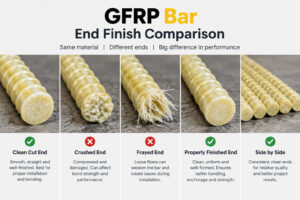
If a piece fails your visual check, set it aside. Recutting a short section of bar costs far less than installing a damaged end.
Common GFRP Cutting Problems and How to Fix Them
| Problem | Possible Causes | What to Try |
| Crushed end | Shearing or crushing tool, excessive force | Switch to a sawing or abrasive method and use lighter pressure |
| Frayed fibers | Unsuitable or worn blade, bar movement, poor technique | Change the blade, clamp the bar and slow your feed |
| Excessive dust | Uncontrolled dry cutting, weak extraction | Move extraction closer to the cut and improve ventilation |
| Uneven cut | Unsecured bar, tool movement, poor setup | Mark all around, clamp firmly and support both sides |
| Excess heat | Wrong blade, too much pressure, rushed technique | Reduce pressure and use a blade suited to the material |
These are common patterns, not definitive diagnoses. If problems continue, check with the bar manufacturer.
Cutting GFRP Rebar for Small Jobs vs. Large Projects
Your best method changes with volume.
A few cuts or field adjustments. A portable tool like an angle grinder with a diamond blade or a reciprocating saw usually makes sense. Keep a vacuum close and clamp the bar.
Dozens of identical pieces. Set up a repeatable station. A fixed clamp, a length stop and a consistent cutting tool save time and keep lengths accurate.
Hundreds or thousands of pieces. Think production. A stationary saw with a cutting stop or jig, dedicated dust collection and a clear worker-protection plan keep quality steady and reduce exposure.
Bent shapes are a separate matter. If your design needs shaped reinforcement, it is often better to specify bent GFRP rebar than to try to cut and shape bars on site.
GFRP Rebar Cutting Safety Checklist
Print this and keep it at the cutting station.
- [ ] Manufacturer’s instructions reviewed
- [ ] Bar diameter confirmed
- [ ] Suitable tool and fresh blade selected
- [ ] Bar clamped and supported
- [ ] Dust extraction in place
- [ ] Respirator, eye protection, gloves and long sleeves on
- [ ] Bystanders kept clear
- [ ] Cut ends inspected
- [ ] Damaged pieces separated
- [ ] Area cleaned with a filtered vacuum
MRG Composites’ Approach to GFRP Rebar Handling
MRG Composites has 18 years in the industry and is India’s 1st BIS License holder for GFRP rebar. Our bars are available in diameters from 3 mm to 22 mm, and we work with contractors across more than 5000 projects.
Because bar construction and diameter affect how a bar cuts, always confirm tool and blade choices with our technical team for your specific product. We are happy to guide you before your crew picks up a saw.
Final Thoughts
Cutting fiberglass rebar is not hard. It just asks for a different mindset than cutting steel.
Choose the tool for the job, control dust before it spreads and inspect every cut end. Do those three things and your crew will move faster with fewer rejected pieces.
Planning a project and want to know more about the bars themselves? Explore MRG Composites, check our GFRP bar price guide or request a quote from our team. We will help you get the right bar, and the right advice on handling it, from day one.