
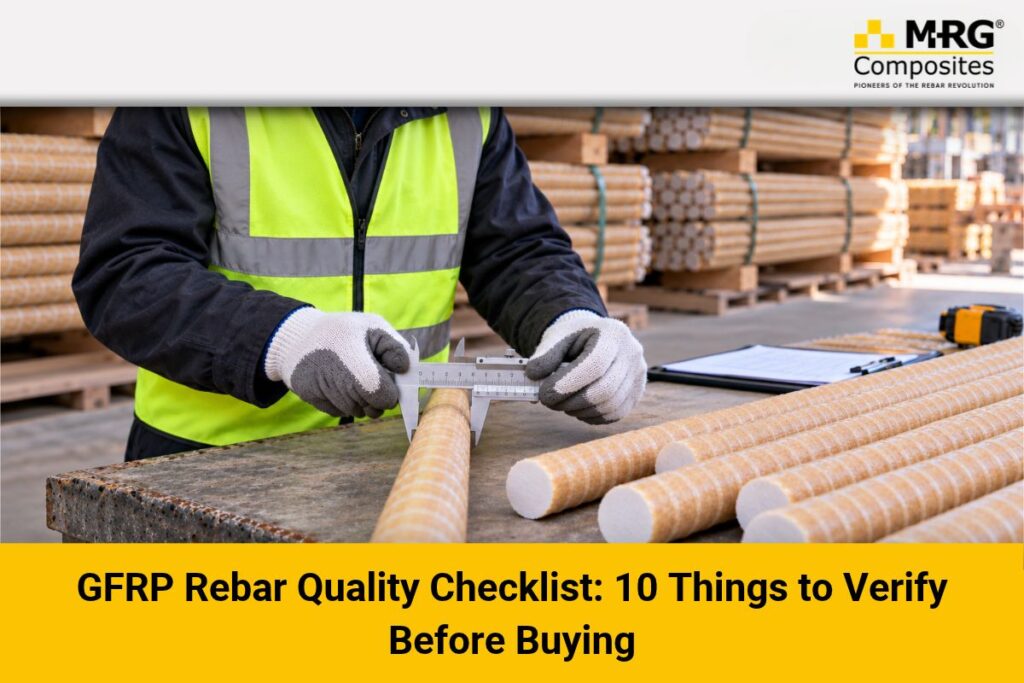
Two GFRP bars can look identical on a pallet. Same color, same surface, same diameter on the label.
One may have been made, tested and certified properly. The other may have a brochure and a promise.
You cannot tell them apart by eye. And once bars are inside concrete, you cannot inspect them again.
That is why GFRP rebar quality has to be verified before you buy, not after you pour. This checklist walks you through ten things to check, what document to ask for and which red flags to watch for.
What Defines Good-Quality GFRP Rebar?
Good GFRP rebar quality is not one number. It is a combination of material, manufacturing, mechanical performance, durability, testing and documentation.
The biggest mistake buyers make is judging a bar by tensile strength alone. A high MPa figure on a brochure tells you very little without the standard, test method and test report behind it.
A better approach is to ask three questions:
- Which standard does the product meet?
- Which tests prove it?
- Can the manufacturer show the documents?
The ten checks below answer all three.
10 Things to Check Before Buying GFRP Rebar
1. Applicable Product Standard
Start by asking one simple question: which standard does this bar comply with?
In India, the key reference is IS 18256:2023, the specification for solid round GFRP bars for concrete reinforcement. According to BIS, it covers the required physical, chemical and mechanical properties. Its companion, IS 18255:2023, covers the methods of test.
For international work, ASTM D7957/D7957M is a widely used specification for solid round GFRP bars. It covers geometry, materials, mechanical and physical properties, plus quality control, certification, marking and traceability.
What to do with this: ask the supplier to name the exact standard and edition. Then confirm it suits your project. For example, BIS notes that roads, highways and bridges should also refer to the relevant IRC guidance.
2. Fibre Content
Glass fibre carries the load in a GFRP bar, so fibre content matters.
ASTM D7957 lists fibre mass content as a physical property for qualification and quality control. BIS testing records for IS 18256 also list fibre content by mass fraction.
Be careful here. More fibre does not automatically mean a better bar. Fibre content is one parameter, and it must be judged alongside the resin system, mechanical properties and the standard’s requirements.
Ask for: the documented fibre content and how it was verified.
3. Tensile Strength and Mechanical Properties
Tensile strength is the number everyone asks about. It should be just one line in your review.
Look for these together:
- Ultimate tensile force or strength
- Tensile modulus
- Ultimate tensile strain
- The test method used
- The bar size tested
ASTM D7957 specifies all three tensile properties. A number without a test method or bar size is just a marketing claim.
Ask for: a test report showing tensile results for the exact diameter you are buying.
4. Bond Strength
Concrete and reinforcement only work as a team if the bar grips the concrete.
That grip is bond strength. Many articles skip it, yet both ASTM D7957 and the IS 18256 testing scope include it.
A bar with impressive tensile numbers but poor bond will not perform as intended. So ask to see it.
Ask for: bond strength results and the method used to measure them.
5. Resin Quality, Glass Transition Temperature and Degree of Cure
The resin holds the fibres together and passes load between them. How well it is cured affects the bar’s long-term behavior.
Two properties tell you this:
- Glass transition temperature shows the temperature range where the resin softens.
- Degree of cure shows how completely the resin has hardened.
Both appear in ASTM D7957 and in BIS testing parameters for IS 18256.
You do not need to be a chemist. You just need to know these values were tested and reported.
Ask for: glass transition temperature and degree of cure results.
6. Cross-Sectional Area and Dimensions
Do not trust the label diameter alone.
Ask for the nominal diameter, the measured cross-sectional area and the dimensional tolerances. Both ASTM D7957 and IS 18256 testing include measured cross-sectional area.
This matters because structural design depends on the actual area, not the printed size. It also matters for shaped bars, so if your design needs them, confirm the specification for bent GFRP rebar as well.
Ask for: measured area and tolerance data for each diameter.
7. Durability Testing
A bar can look strong on day one. What matters is how it holds up in concrete over time.
Durability parameters to check include:
- Moisture absorption
- Resistance to alkaline environment
- Any other durability requirement that applies to your project
Concrete is alkaline, so alkali resistance is especially relevant. Both ASTM D7957 and IS 18256 testing list these properties.
Ask for: durability test results and confirmation they suit your exposure conditions.
8. Production-Lot Quality Test Reports
“Our product meets the standard” is not evidence. A test report is.
ASTM D7957 separates qualification testing from quality control of production lots. That difference matters. A one-time qualification test does not prove that the lot delivered to your site was tested.
Ask these questions:
- Which standard and test methods were used?
- Which bar size and production lot were tested?
- What was the test date?
- Which laboratory did the testing?
- Do the results meet the required limits?
Ask for: lot-specific reports for the material you are buying.
9. Certification and Traceability
Certification should be verifiable, not just displayed.
Check these details:
- Certificate or licence number
- Validity period
- Manufacturer name
- Products covered by the certificate
- Standard it applies to
- Batch or lot identification
- Product marking and labels
We hold a BIS licence for IS 18256:2023 (CM/L-7600217414). BIS lists MRG Composites India Private Limited as the licensee for solid round GFRP bars for concrete reinforcement in its All India 1st Licence circular. You can view our BIS certificate and related documentation in our Certificates.
A certificate confirms compliance with a specific manufacturing and testing standard. For complete product verification, check the certificate, its scope, and the lot details for delivery traceability.
10. Manufacturer’s Technical Capability
The last check is about the company behind the bar.
A good manufacturer can show:
- Years of manufacturing experience
- A documented quality-control process
- In-house or accredited testing
- Consistent production
- Technical datasheets and installation guidance
- Relevant project experience
- Ability to supply the sizes and shapes you need
Ask for: examples of similar projects and a named technical contact.
How to Read a GFRP Rebar Test Report
A test report can look intimidating. It is really a table that answers one question per row: did the result meet the requirement?
Here is how to read one.
| Section | What It Tells You | What to Check |
| Product and size | Which bar was tested | Matches the diameter you are buying |
| Standard | Which requirements apply | Named and current |
| Test method | How the result was measured | Matches the standard |
| Result | The measured value | Actual number, not a range from a brochure |
| Required value | The standard’s limit | Listed alongside the result |
| Pass or fail | Whether it meets the limit | Clear and unambiguous |
| Lot and date | Which batch and when | Matches your delivery |
| Laboratory | Who tested it | Identified by name |
Work through the same row check for tensile force, tensile modulus, fibre content, bond strength, moisture absorption, alkaline resistance and cross-sectional area.
If a report leaves out the size, method or lot, treat it as incomplete.
Can You Check GFRP Rebar Quality by Appearance?
Only partly.
A quick visual check can catch obvious problems. On delivery, look for:
- Inconsistent surface finish
- Visible cracks or voids
- Resin-rich areas
- Exposed or loose fibres
- Uneven texture or sizing
- Damage from transport
But visual inspection is a screening step. It cannot confirm tensile strength, bond, durability or compliance with a standard. Only testing and certification can do that.
Handling matters too. Poor cutting can damage a good bar, so read our guide on how to cut fiberglass rebar before your crew starts work.
7 Red Flags When Buying GFRP Rebar
Watch out if a supplier:
- Offers a brochure but no test documentation
- Advertises only tensile strength
- Does not clearly name a standard
- Gives results without size or test method
- Has certification you cannot verify
- Cannot provide batch or lot traceability
- Has no technical documents for the exact product supplied
One red flag deserves a question. Several deserve a different supplier.
GFRP Rebar Buying Checklist
Copy this into your procurement file.
- [ ] Applicable product standard verified
- [ ] Manufacturer certification verified
- [ ] Product diameter and size verified
- [ ] Fibre content documented
- [ ] Tensile strength, modulus and strain documented
- [ ] Bond strength documented
- [ ] Cross-sectional area verified
- [ ] Resin properties (glass transition, degree of cure) reviewed
- [ ] Durability testing reviewed
- [ ] Test laboratory identified
- [ ] Production-lot testing available
- [ ] Batch and lot traceability available
- [ ] Product marking verified
- [ ] Technical datasheet received
- [ ] Installation guidance received
- [ ] Manufacturer experience reviewed
How MRG Composites Demonstrates GFRP Rebar Quality
As a leading GFRP rebar manufacturer in India,, We would rather you verify us than trust us. Here is what we can put in front of you:
- BIS licence for IS 18256:2023 (CM/L-7600217414)
- ISO 9001:2015 certification
- Bars in diameters from 3 mm to 22 mm, plus bent and shaped rebar
- 18 years in the industry and more than 5000 projects completed
- Project experience on infrastructure

Final Thoughts
Buying GFRP rebar is a trust decision that should be backed by paperwork.
Ask for the standard. Ask for the lot report. Ask for the certificate. Then ask the manufacturer to explain what each number means. A good supplier will be glad to.
If you are planning a project and want a second pair of eyes on your specification, talk to the team at MRG Composites. You can also check our GFRP bar price guide to plan your budget before you request a quote.