GFRP Rebar Advantages — Stronger, Lighter & Corrosion-Free Reinforcement
Discover why engineers across India and worldwide choose MRG Composites GFRP rebar over steel — superior tensile strength, up to 75% lighter weight, total corrosion resistance, non-conductivity, and a lower lifetime cost. India's first BIS-licensed GFRP rebar manufacturer.

Why Choose GFRP Rebar Over Steel?
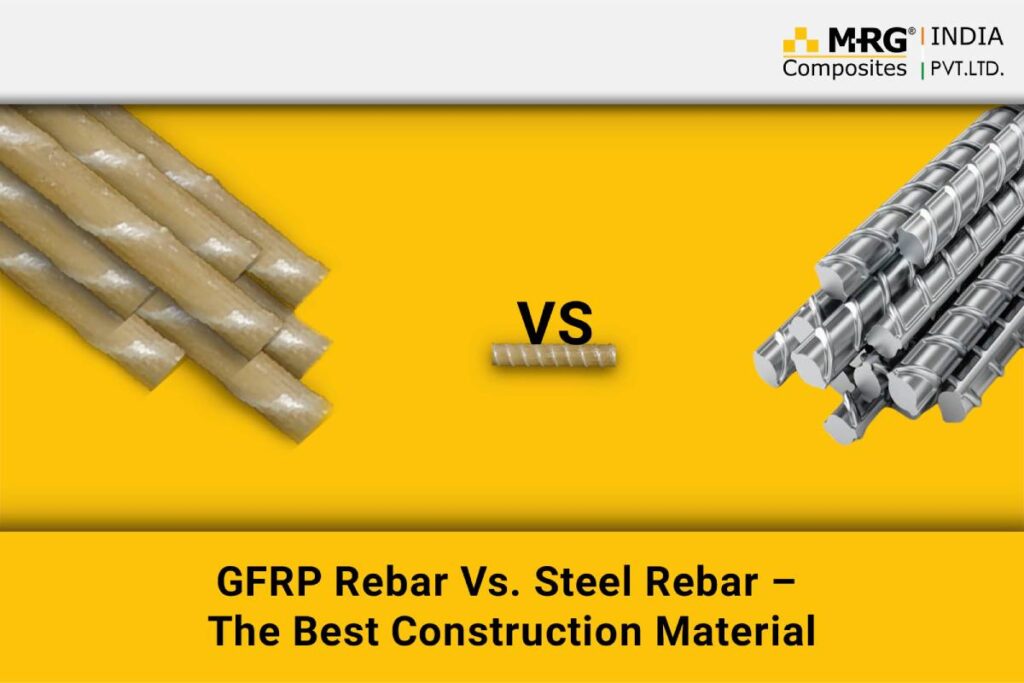
GFRP (Glass Fibre Reinforced Polymer) rebar is a composite reinforcement bar made from high-strength glass fibres bound in a polymer resin matrix. It replaces traditional steel rebar with a material that is corrosion-resistant, non-conductive, twice as strong, and roughly a quarter of the weight — manufactured in India under ISO 9001:2015 certification by MRG Composites, India’s first BIS licence holder for GFRP bars.
Key Advantages of GFRP Rebar

High Tensile Strength
GFRP rebar delivers a tensile strength of 1000+ MPa — more than double the 500–600 MPa of conventional Grade 60 steel rebar. This high strength-to-weight ratio lets engineers reinforce the same structural section with less material, giving bridges, industrial floors, and highways superior resistance to cracking and deformation under sustained heavy loads. Unlike high-strength steel, GFRP achieves this without brittleness or the corrosion-driven loss of strength that weakens steel over time.

Lightweight — One-Quarter the Weight of Steel
At a density of just 1.9 Ton/m³ against steel's 7.8, GFRP rebar is roughly four times lighter than equivalent steel reinforcement. A single truck carries up to four times more GFRP than steel, cutting freight costs and the number of trips. On site, lighter bars mean faster handling, reduced crane and labour requirements, and lower dead load on foundations — a decisive advantage for bridges, high-rises, and seismic-zone construction where every kilogram compounds.

Non-Conductive & Non-Magnetic
Because GFRP rebar is made from glass fibres set in a polymer resin matrix, it neither conducts electricity nor distorts magnetic fields. This makes it the mandated reinforcement for MRI suites, hospitals, data centres, power substations, toll plazas, and railway installations — anywhere steel would cause electromagnetic interference or earthing hazards. The dielectric property also eliminates stray-current corrosion risk in tunnels and underground infrastructure.

Corrosion-Resistant & Durable
GFRP rebar does not rust — ever. The polymer matrix seals every glass fibre against water, chlorides, salts, acids, and de-icing chemicals, so there is zero corrosion even in alkaline concrete, coastal, and marine environments. Where steel reinforcement degrades within 20–25 years and demands repeated repair, GFRP delivers a maintenance-free service life of 80–100+ years, preserving structural integrity in the harshest conditions.

Cost-Effective Over the Project Lifetime
The right way to compare GFRP rebar price is cost per year of service life, not the upfront figure. By eliminating corrosion repair, structural remediation, and premature replacement, GFRP removes the single largest recurring cost in reinforced concrete. Its light weight cuts transport and labour costs from day one, and custom coil lengths reduce overlap waste. Across a 50-year project, the total cost of ownership consistently favours GFRP over steel.
GFRP Rebar vs. Steel Rebar: Side-by-Side Comparison
| PROPERTY | STEEL REBAR | MRG GFRP REBAR |
|---|---|---|
| Tensile Strength (MPa) | 500-600 | 1000+ |
| Density (Ton/m³) | 7.8 | 1.9 |
| Corrosion Resistance | Rusts & corrodes | 100% corrosion-resistant |
| Electrical Conductivity | Conductive | Non-conductive |
| Service Life | 20-25 years | 80-100+ years |
| Maintenance Cost | High — recurring repairs | Low — virtually maintenance-free |
Our Certifications & Quality Standards

IS : 18256 : 2023 Certificate
Our GFRP Rebars are manufactured in compliance with IS 18256:2023, ensuring high standards of strength, durability, and performance for use in structural and infrastructure applications.

ISO 9001:2015 Certificate
We are certified under ISO 9001:2015, reflecting our commitment to consistent quality, efficient processes, and continuous improvement across our manufacturing and customer service operations.
Switch to Stronger, Lighter, Corrosion-Free Reinforcement
Get a free, project-specific quote and see exactly how much GFRP Rebar saves you in strength, weight, and lifetime cost versus steel.Have Questions?We've Got Answers

Get In Touch
Want to know which GFRP rebar advantage matters most for your project? Share your requirements and our team will provide a tailored quote and technical guidance.