

Choosing the right GFRP Rebar diameter starts with structural design calculations, not the steel bar size used in previous projects. A 12 mm GFRP bar does not perform like a 12 mm steel bar because the two materials have different strength, stiffness and bond properties.
This guide explains standard GFRP Rebar diameters in India, how diameter affects tensile strength and what engineers should consider when selecting bar sizes.
Whether you are an engineer, contractor or buyer, understanding these factors will help you make informed decisions when specifying or purchasing GFRP Rebar.
Understanding GFRP Rebar Diameters and Sizes
GFRP Rebar is available in different sizes, such as G8, G10 and G12. The number represents the bar’s nominal diameter in millimetres. Each size also has a specified cross-sectional area under IS 18256:2023.
To understand GFRP Rebar sizes, it helps to know three basic terms:
- Nominal diameter: The standard size used to identify a bar, such as 8 mm or 12 mm.
- Measured cross-sectional area: The average area of the finished bar, including its coating, ribs or lugs. This is measured according to IS 18255.
- Calculated diameter: The diameter calculated from the measured cross-sectional area. IS 18256 uses this value for bar designation and design. If it falls between two standard sizes, the next smaller nominal size applies.
Why does this matter when selecting GFRP Rebar?
Surface features such as sand coating and ribs can make a bar look thicker than its actual design diameter. When purchasing GFRP Rebar, check the manufacturer’s test certificate to confirm the bar size instead of relying only on its catalogue description.
Standard GFRP Rebar Sizes Available in India
IS 18256:2023 defines nine GFRP Rebar sizes, from G4 (4 mm) to G32 (32 mm). Each size has a specified nominal diameter, cross-sectional area and minimum guaranteed tensile force.
The following table shows the standard sizes and their key requirements.
| Size | Nominal diameter (mm) | Nominal area (mm²) | Min. tensile force – straight bar (kN) | Min. tensile force – straight portion of bent bar (kN) | Min. bend radius (mm) |
| G4 | 4 | 12.6 | 11 | 6 | 12 |
| G6 | 6 | 28.3 | 23 | 14 | 18 |
| G8 | 8 | 50.3 | 40 | 24 | 24 |
| G10 | 10 | 78.5 | 60 | 35 | 30 |
| G12 | 12 | 113.1 | 80 | 50 | 36 |
| G16 | 16 | 201.1 | 130 | 80 | 48 |
| G20 | 20 | 314.2 | 190 | 120 | 60 |
| G25 | 25 | 490.9 | 270 | 160 | 100 |
| G32 | 32 | 804.2 | 420 | Not specified | Not specified |
Source: IS 18256:2023.
The standard also specifies acceptable limits for the measured cross-sectional area of each size.
Check GFRP Rebar Sizes at MRG Composites.
How Does GFRP Rebar Diameter Affect Strength and Performance?
The diameter of a GFRP Rebar affects its cross-sectional area and tensile capacity. A larger diameter provides more area to carry tensile loads, but tensile force does not increase at the same rate as cross-sectional area.
For a round GFRP bar, the cross-sectional area is calculated using:
[
A = \frac{\pi d^2}{4}
]
Here, A is the cross-sectional area and d is the bar diameter.
For example, a G16 bar has four times the cross-sectional area of a G8 bar. However, its minimum guaranteed tensile force is not four times higher.
How Diameter Affects Tensile Force
IS 18256:2023 specifies the minimum guaranteed tensile force for different GFRP Rebar sizes. Larger bars have lower tensile force per unit area because of the size effect.
For example:
- A G12 bar has about 2.25 times the area of a G8 bar, but its minimum tensile force is only twice as high.
- A G16 bar has four times the area of a G8 bar, but its minimum tensile force is only 3.25 times higher.
This means a larger diameter does not automatically provide a proportional increase in tensile capacity. Engineers must consider the actual bar properties when selecting a size.
Why Stiffness Also Matters
Tensile strength is not the only factor to consider. GFRP Rebar is less stiff than steel, which affects how concrete structures bend and crack under loads.
IS 18256:2023 specifies a minimum mean tensile modulus of 45 GPa and a minimum mean ultimate tensile strain of 1.1%.
Engineers should check stiffness, deflection and crack width along with tensile strength when selecting GFRP Rebar sizes.
Important: Always check the manufacturer’s certified test reports and minimum guaranteed tensile force when assessing a specific GFRP Rebar product. The standard’s minimum values should not be treated as the actual tested strength of every bar.
What Factors Affect GFRP Rebar Diameter Selection?
The required GFRP Rebar diameter depends on the structure, its loading conditions and the properties of the bar. Before finalising the size and spacing, the structural engineer considers several factors.
- Loads and spans
The loads on the structure and the distance between supports determine how much tensile force the reinforcement needs to carry.
- Tensile strength and stiffness
The bar’s certified tensile capacity and modulus of elasticity affect how it carries loads and resists deformation.
- Deflection and crack width
GFRP Rebar has lower stiffness than steel. Engineers need to check how much the concrete structure may bend and how wide cracks may become under service loads.
- Bar spacing
The number of bars and the distance between them affect crack control and reinforcement distribution. Smaller bars placed closer together may perform differently from larger bars with wider spacing.
- Concrete cover and bond strength
The selected bar size must meet concrete cover requirements. The bar’s surface treatment also affects how well it bonds with concrete. IS 18256 specifies a minimum guaranteed bond strength of 7.6 MPa.
- Development length and shear strength
Engineers must calculate the required development length and check shear performance according to the applicable design provisions. IS 18256 specifies a minimum guaranteed transverse shear strength of 130 MPa.
- Fatigue and creep
For structures exposed to repeated loading or long-term sustained stress, engineers may also need to check fatigue and creep performance.
A larger GFRP Rebar diameter is not always the better choice. Fewer, thicker bars may increase spacing and affect crack control. On the other hand, using too many smaller bars can create congestion inside the concrete. The right combination of diameter and spacing must come from structural calculations.
For product properties and technical details, review our GFRP Rebar specifications.
GFRP Rebar Diameter Selection for Different Applications
The right GFRP Rebar size depends on the type of structure. The requirements for a concrete slab can be quite different from those for a bridge or water tank.
Here are some factors engineers consider for different applications:
- Concrete slabs: Span, loads, deflection and crack control.
- Industrial flooring: Vehicle and equipment loads, slab thickness and joint design.
- Foundations: Soil conditions and the loads transferred to the foundation.
- Roads and pavements: Traffic loads, pavement thickness and reinforcement spacing.
- Bridges: Structural loads, repeated loading and durability requirements.
- Water tanks: Water pressure and crack control.
- Retaining walls: Soil pressure, wall height and reinforcement requirements.
IS 18256:2023 also covers GFRP Rebar use in certain concrete structures where the consequences of failure are considered low by the design engineer. Examples include pavements, floorings, drainage structures, fences and manhole covers. These structures must still meet the required safety and performance criteria.
For road and bridge projects, engineers should also refer to the relevant Indian Roads Congress guidelines. Learn more about these applications on our GFRP reinforcement for roads and GFRP rebar for bridge construction pages.
GFRP Rebar vs Steel Rebar Diameter: What Is the Difference?
Many people assume they can replace 12 mm steel bars with 12 mm GFRP bars. However, this is not a direct replacement because the two materials have different properties.
Here are some important differences engineers need to consider:
- Tensile strength: Depends on the GFRP bar size and manufacturer’s certified values.
- Elastic modulus: GFRP is less stiff than steel. IS 18256 specifies a mean minimum of 45 GPa.
- Deflection: Must be checked during structural design.
- Crack width: Needs to be considered when selecting bar size and spacing.
- Bond strength: Depends on the bar’s surface profile and tested bond properties.
- Development length: Must be calculated using the applicable design code.
- Failure behaviour: GFRP does not yield like steel. It remains linear-elastic until it breaks.
Even a GFRP bar with high tensile strength may need a different diameter or spacing to meet deflection and crack-width requirements. Engineers should consider these factors rather than simply replacing steel bars with GFRP bars of the same diameter.
To understand the key differences between the two materials, read our blog on GFRP Bar vs Steel Bar.
Straight GFRP Bars vs Factory-Bent Bars
GFRP cannot be bent on site. As per IS 18256:2023, bent bars such as stirrups and hooks must be manufactured at the factory.
Keep these points in mind when ordering:
- Bend radius: The minimum bend radius depends on the bar diameter. It is three times the diameter for sizes up to G20 and four times for G25. The standard does not specify bent bars for G32.
- Tensile force at bends: A bent bar has a lower guaranteed tensile force than a straight bar. For example, a G12 bent bar must have a minimum guaranteed force of 50 kN in its straight portion, compared with 80 kN for a straight bar.
- Bar Bending Schedule (BBS): Finalise the BBS before placing your order. Include the bar size, cut length, surface finish and bending details such as shape, angle, leg length and bend radius.
- Transportation: Bars up to 12 mm can be supplied in coils or straight lengths. Larger bars are generally supplied in 8 m or 12 m bundles.
Discuss the bar sizes and bending requirements with your structural engineer before placing an order. Changes after production starts can increase costs and cause delays.
Learn more about factory-made shapes and specifications on our GFRP Bent Bars page.
What Standards Should You Check Before Selecting GFRP Rebar?
Four important standards and guidelines help engineers understand GFRP Rebar specifications and design requirements:
- IS 18256:2023: Covers GFRP Rebar sizes, material requirements, tensile strength, modulus, bond strength, durability and bent bars.
- IS 18255:2023: Explains test methods for FRP bars, including cross-sectional area measurement.
- IRC:137-2022: Provides guidelines for using GFRP bars in road projects.
- ACI CODE-440.11-22: Covers design requirements for concrete structures reinforced with GFRP bars.
Why do these standards matter?
IS 18256:2023 sets the product requirements for GFRP Rebar. It explains the properties a bar must meet, but it does not cover the complete structural design process. Engineers should also follow the relevant design codes and guidelines for their projects.
When checking a manufacturer’s test reports, look for these key requirements under IS 18256:2023:
- Glass fibre content: At least 75% by mass.
- Glass transition temperature: At least 100°C.
- Degree of cure: At least 95%.
- Mean tensile modulus: At least 45 GPa.
Why Choose MRG Composites for GFRP Rebar?
MRG Composites has manufactured and supplied GFRP rebar since 2019. MRG Composites India Pvt Ltd, Rajkot, is also listed among the organisations on the BIS working group that formulated the standards for FRP bars (CED 54/WG 5), the group behind IS 18256:2023.
We supply technically specified reinforcement and leave final structural selection to the project’s qualified design engineer. Our team can share product specifications, test information and BIS certification details, and can discuss size availability, factory-bent bars and project requirements.
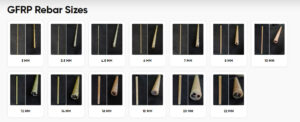
Looking for the right GFRP rebar diameter for your construction project? Explore MRG Composites’ available GFRP bar sizes and contact our team for product specifications and project requirements.