
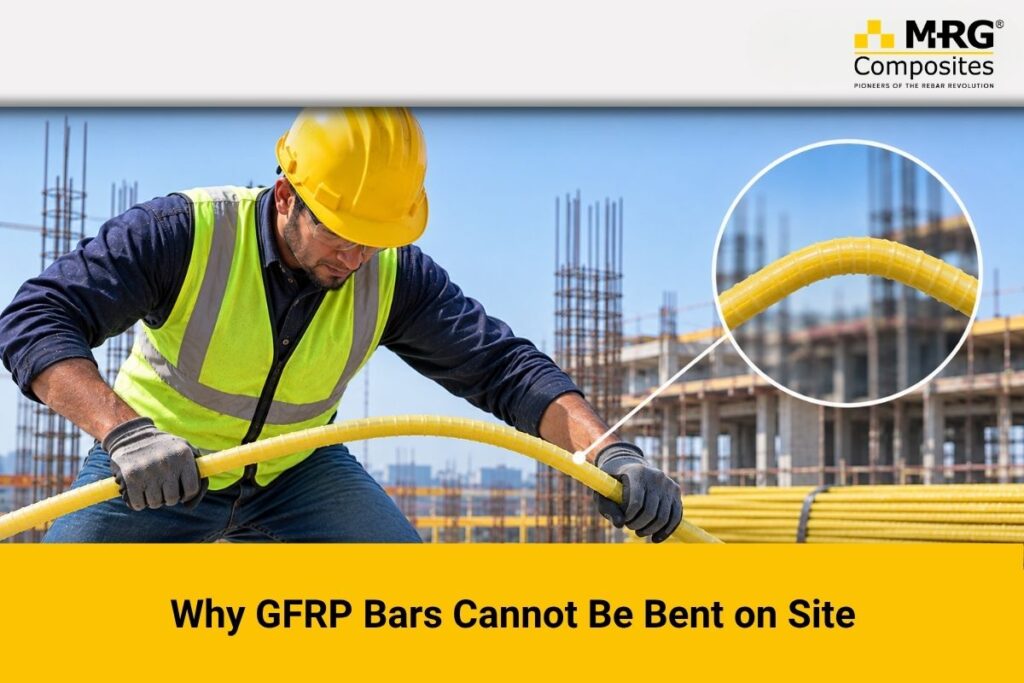
GFRP bars are increasingly used as an alternative to steel reinforcement in concrete structures. They are lightweight, corrosion-resistant, and non-metallic, which makes them suitable for projects where long-term durability is important.
But one question often comes up during construction: can GFRP Rebars be bent on site?
In most cases, the answer is no. GFRP bars are manufactured with continuous glass fibers running through the length of the bar. Their strength depends heavily on these fibers and the way they are embedded in the resin matrix. Trying to bend a straight GFRP bar at a construction site can damage this structure and reduce its intended performance.
This is why bends need to be planned before the bars reach the job site.
How Are GFRP Bars Different From Steel Bars?
Steel rebar is a ductile metal. It can be bent using suitable equipment and, within the required limits, reshaped at the construction site.
GFRP is a composite material. It consists of glass fibers held together by a polymer resin. The fibers provide much of the bar’s tensile strength, while the resin binds and protects them.
This difference affects how the reinforcement behaves during fabrication and installation.
With steel, a contractor can often take a straight bar and bend it to the required angle using a rebar bending machine.
With GFRP, bending a finished straight bar is not the same process. The bend needs to be manufactured using the correct process, materials, dimensions, and curing conditions.
Can GFRP Rebars Be Bent on Site?
GFRP Rebars should not be field-bent on site.
A straight GFRP bar is manufactured to provide its specified structural properties. Applying an uncontrolled bending force after manufacturing can damage the glass fibers or resin matrix.
The problem might not always be visible from the outside. A bar could look acceptable after bending while its internal fibers have already been damaged.
For this reason, required bends should be identified during the design and ordering stage.
If a project requires hooks, stirrups, L-shapes, U-shapes, or other configurations, these should be manufactured to the required dimensions rather than created from straight bars at the job site.
Why Does GFRP Bar Bending Need to Happen During Manufacturing?
GFRP bars are produced through a controlled manufacturing process. The glass fibers are aligned and impregnated with resin before the material is formed and cured.
Creating a bend requires a different manufacturing approach from producing a straight bar.
The bend radius, angle, dimensions, fiber arrangement, resin system, and curing process all need to be controlled. This helps ensure the finished component has the required shape and performance.
This is why GFRP bar bending is normally handled by the manufacturer rather than by workers at the construction site.
What Happens If You Bend GFRP Bars on Site?
Improper bending can create several problems.
Fiber Damage
The glass fibers carry a significant portion of the tensile load. Excessive bending can break, distort, or damage these fibers.
Resin Damage
The polymer resin holds the fibers together and protects them. Incorrect bending forces can cause cracking or separation within the composite.
Reduced Structural Performance
A visually acceptable bend does not guarantee that the bar will retain its designed properties. Damage to the fiber-resin system could reduce the reinforcement’s performance.
Inconsistent Bend Geometry
Site bending does not provide the same level of control as factory production. Variations in angle, radius, and dimensions can create installation and detailing problems.
Installation Delays
If reinforcement arrives in the wrong configuration, attempting to modify it on site can create additional work and delays. Ordering the required shapes in advance avoids this issue.
How Are GFRP Bent Bars Manufactured?
Manufacturers produce GFRP bent bars using controlled processes designed specifically for composite reinforcement.
The required shape is established from the structural drawings and project specifications. The manufacturer then produces the bar with the required bend angle, dimensions, and radius.
Depending on the project, the required configuration could include:
- L-shaped bars
- U-shaped bars
- J-shaped bars
- C-shaped bars
- Stirrups
- Hooks
- Custom bend configurations
The exact available shapes depend on the manufacturer and the project requirements.
What Are Factory-Bent GFRP Bars?
Factory-bent GFRP bars are reinforcement components manufactured with the required bend before delivery to the construction site.
Instead of receiving straight bars and trying to modify them during installation, contractors receive reinforcement that is already produced according to the project drawings.
This approach provides several practical benefits:
- Correct dimensions before delivery
- Consistent bend geometry
- Reduced site modification
- Easier installation planning
- Lower risk of accidental bar damage
- Better coordination between reinforcement drawings and supplied material
For projects with complex reinforcement detailing, factory production also makes it easier to plan quantities and shapes before construction begins.
What Are Pre-Bent GFRP Rebars Used For?
Pre-bent GFRP Rebars are useful wherever concrete reinforcement requires a specific shape or change in direction.
Common applications include:
- Footings
- Beams
- Columns
- Walls
- Slabs
- Foundations
- Retaining structures
- Bridge components
- Marine structures
- Industrial structures
The reinforcement shape should always follow the structural drawings and engineering specifications.
Common GFRP Bend Shapes
Different projects require different reinforcement configurations. Some commonly requested GFRP bend shapes include L-bends, U-bends, hooks, and other custom profiles.
The required bend radius is particularly important. GFRP should not be forced into a tight radius without considering the manufacturer’s capabilities and the design requirements.
When preparing reinforcement schedules, engineers should provide the manufacturer with accurate dimensions rather than relying on site modifications.
What Should Engineers Specify When Ordering Bent GFRP?
Good planning starts with the reinforcement drawings.
Engineers and procurement teams should provide details such as:
- Bar diameter
- Overall length
- Bend angle
- Bend radius
- Straight lengths
- Required quantity
- Shape or configuration
- Project-specific requirements
- Delivery requirements
Clear drawings help the manufacturer produce the required reinforcement accurately.
It is also useful to coordinate the reinforcement schedule with the concrete design before placing the order. A small change in the required dimensions after manufacturing could affect the installation process.
What Should Contractors Do When GFRP Arrives on Site?
Once the reinforcement reaches the project site, it should be handled carefully.
Inspect the Delivery
Check the supplied bars against the reinforcement schedule. Confirm the diameter, quantity, length, and shape.
Avoid Field Modification
Do not attempt to bend straight GFRP bars to create a required angle. If a supplied bar does not match the drawings, contact the manufacturer or project engineer before making changes.
Store Bars Properly
Follow the manufacturer’s storage instructions. Keep the reinforcement protected from unnecessary damage during handling and storage.
Handle With Care
Although GFRP is lightweight, it is still a composite material. Avoid dragging bars across rough surfaces or using handling methods that could damage the bar surface.
Follow the Installation Drawings
Place the reinforcement according to the approved structural drawings and project specifications.
What If a Different Bend Is Needed After Delivery?
Construction changes do happen. A contractor might discover that a particular bar needs a different dimension or configuration after the reinforcement has already been delivered.
The safest approach is to stop and confirm the requirement with the structural engineer and GFRP manufacturer.
Do not assume a straight bar can be modified to solve the problem.
If a new configuration is required, the manufacturer can determine whether a replacement or newly manufactured bent component is needed.
Why Factory Bending Makes GFRP Installation Easier
The main advantage of factory bending is simple: the reinforcement arrives ready for its intended application.
This allows the site team to focus on placement instead of trying to modify the material.
For large construction projects, this can improve coordination between reinforcement schedules, material deliveries, and installation activities.
It also reduces the risk of treating GFRP like steel and attempting to use conventional steel-rebar bending practices.
Choosing the Right GFRP Reinforcement
GFRP reinforcement is available in different diameters, lengths, and configurations. Selecting the correct product requires more than choosing a bar size.
Engineers should consider the structural design, required shape, environmental conditions, applicable design standards, and installation requirements.
For standard reinforcement requirements, you can explore GFRP Bars and review the available product information.
When a project requires specially shaped reinforcement, discussing the requirements with an experienced manufacturer before ordering helps avoid site-level complications.
For custom reinforcement requirements, GFRP Bent Bars are manufactured according to the required configuration, allowing the reinforcement to arrive ready for installation.

Need Factory-Bent GFRP Bars?
Why Choose MRG Composites for GFRP Reinforcement?
At MRG Composites, we manufacture GFRP reinforcement in India for projects that require durable, lightweight, and non-metallic reinforcement solutions. Our experience in composite manufacturing helps us understand the practical requirements involved in producing and supplying GFRP reinforcement for different construction applications.
Our GFRP bars are manufactured in line with applicable quality and product standards. We hold BIS Licence No. CM/L-7600217414 for GFRP bars under IS 18256:2023 and operate with an ISO 9001:2015 quality management system.
We supply both straight GFRP bars and specially shaped reinforcement, including bent bars manufactured according to project requirements. Our team works with engineers, contractors, and procurement teams to understand bar sizes, lengths, shapes, and other project specifications before production.
If you are evaluating GFRP reinforcement for your next project, explore our GFRP Bars or contact us to discuss your specific reinforcement requirements.
Final Thoughts
GFRP bars offer important advantages for reinforced concrete construction, but they need to be handled differently from steel.
The biggest point to remember is simple: do not plan to bend straight GFRP bars at the construction site.
If your project requires hooks, L-shapes, U-shapes, stirrups, or other configurations, include these requirements in the reinforcement drawings and order them as factory-made components.
Proper planning protects the reinforcement, avoids unnecessary site modifications, and helps the installation team work with bars that are already made for the intended application.
For projects using GFRP reinforcement, choosing the right shape before manufacturing is one of the simplest ways to keep installation smooth and avoid problems on site.