
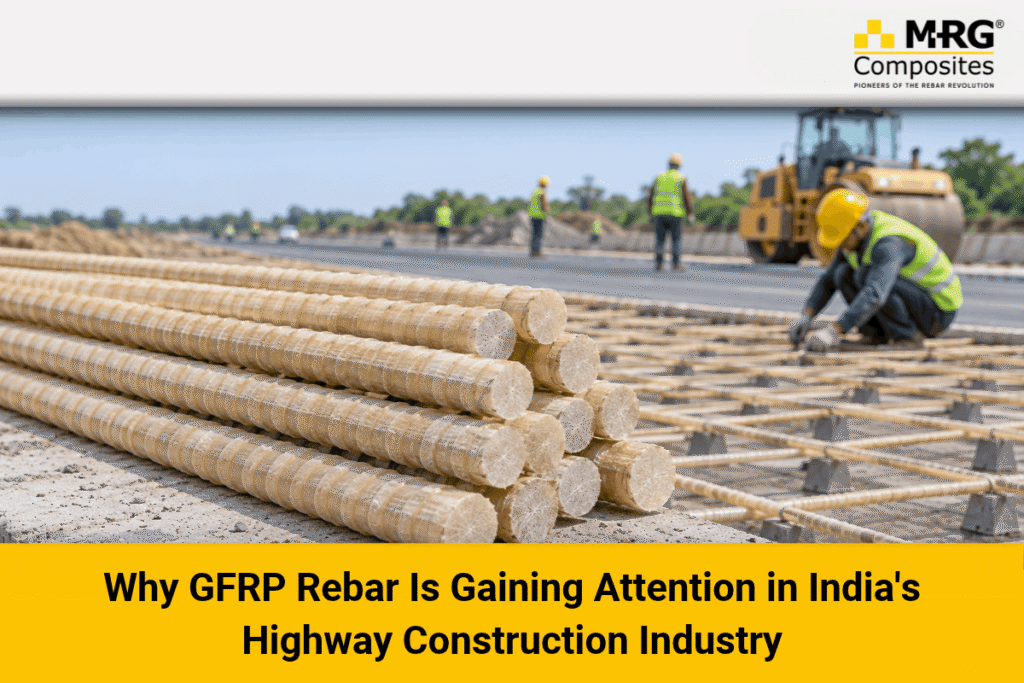
Steel reinforcement often corrodes in highways, bridges and drainage structures due to rainwater, moisture and chemicals. This can damage concrete and increase repair costs.
GFRP Rebar offers an alternative to steel for specific highway applications. But where can it be used, and what should engineers consider when using it?
This article explains GFRP Rebar applications in highway construction, its benefits, relevant Indian standards and how it compares with traditional steel reinforcement.
Growing Challenges in India’s Highway Construction Industry
Steel reinforcement in Indian highways faces several environmental challenges. Rainwater, moisture and chloride exposure can reach the steel inside concrete and cause corrosion. As the steel corrodes, it expands and creates cracks in the surrounding concrete. Over time, this can weaken the structure and increase repair costs.
Some common challenges include:
- Monsoon water exposure: Rainwater keeps roads, bridges and drainage structures wet for long periods.
- Waterlogging: Poor drainage can cause water to collect around roads, culverts and underpasses.
- Chloride exposure: Coastal areas face salt in the air and water, while de-icing salts can affect roads in northern hill regions.
- Heavy commercial traffic: Heavy vehicles and repeated traffic loads can cause cracks and wear in concrete.
- Maintenance difficulty: Repairing damaged bridges, roads and culverts can require road closures, traffic diversions and extra costs.
Proper concrete cover, good-quality concrete and suitable reinforcement help protect highways. GFRP Rebar is another reinforcement option for concrete structures exposed to moisture and harsh weather conditions.
What Is GFRP Rebar?
GFRP (Glass Fibre Reinforced Polymer) Rebar is made from glass fibres and polymer resin. It is lightweight and resistant to corrosion, making it useful for concrete structures exposed to moisture and harsh environmental conditions.
In India, solid round GFRP bars for concrete reinforcement are covered by IS 18256:2023, which specifies their material and performance requirements.
Why Is GFRP Rebar Gaining Attention in Highway Construction?
GFRP Rebar is gaining attention because of its corrosion resistance and lightweight properties. These features make it suitable for highway structures that regularly face moisture, salt and other harsh environmental conditions.
GFRP Rebar offers several benefits for highway construction, including:
- Corrosion resistance: GFRP Rebar does not rust like steel. This helps protect highway structures such as bridges, culverts and drainage systems from corrosion-related damage.
- Lower maintenance requirements: Its corrosion resistance can help reduce repair work caused by reinforcement corrosion, lowering maintenance costs and traffic disruptions on busy highways.
- Easier handling: GFRP Rebar is much lighter than steel. This makes it easier to transport, carry and place at highway construction sites.
- Long-term durability: Its resistance to corrosion makes GFRP Rebar a suitable option for highway structures exposed to rainwater, moisture, road salts and harsh environmental conditions.
- A growing Indian framework: IRC:137-2022 provides guidelines for using GFRP bars in road projects, while IS 18256:2023 specifies product requirements for solid round GFRP bars.
The suitability of GFRP Rebar depends on the highway component, loading conditions, environmental exposure and applicable project specifications.
Where Can GFRP Rebar Be Used in Highway Construction?
GFRP Rebar can be used in different concrete components of highway projects, depending on the structural design and project requirements. Its corrosion resistance makes it a useful reinforcement option for components exposed to rainwater, moisture and road salts.
Some highway applications include:
| Highway component | Potential application of GFRP Rebar |
| Concrete road pavements | Reinforcement in suitable concrete pavement designs |
| Bridge decks | Reinforcement in deck slabs and overlays exposed to moisture |
| Approach slabs | Reinforcement in concrete slabs connecting roads to bridges |
| Box culverts | Reinforcement in concrete drainage structures |
| Crash barriers | Reinforcement in concrete safety barriers |
| Retaining walls | Reinforcement in suitable concrete retaining wall components |
| Drainage structures | Reinforcement in concrete drains and water channels |
IRC:137-2022 and MoRTH Section 3300 provide relevant guidance and requirements for GFRP reinforcement in highway and bridge construction. Engineers should consider these provisions along with structural design requirements and project specifications when selecting reinforcement materials.
At MRG Composites, we manufacture GFRP Rebar for infrastructure and construction applications. Explore our GFRP reinforcement for roads and highways and GFRP rebar for bridge construction applications to learn more.
GFRP Rebar vs Steel Rebar for Highway Construction
GFRP Rebar and steel have different properties, so each project requires a suitable reinforcement design.
GFRP offers corrosion resistance and lower weight, while steel provides higher stiffness and ductile behaviour. The following table compares their main properties.
| Factor | GFRP Rebar | Steel Rebar (TMT) |
| Corrosion resistance | Does not rust | Can corrode in moisture and chloride exposure unless protected |
| Density | About 1.9 g/cm³ | About 7.85 g/cm³ |
| Tensile strength | High; depends on product and diameter | Depends on steel grade |
| Elastic modulus | Generally much lower than steel | About 200 GPa |
| Failure behaviour | Linear-elastic to rupture, without yielding | Ductile yielding before failure |
| Electrical properties | Non-conductive | Conductive |
| Bond with concrete | Depends on surface profile and tested bond properties | Well established for ribbed bars |
| Installation | Lightweight; cutting and factory-formed bends require suitable methods | Familiar site cutting and bending methods |
| Long-term performance | Depends on design, exposure and product quality | Depends on concrete cover, quality and maintenance |
GFRP Rebar can have higher tensile strength than steel, but it is less stiff. This affects how concrete structures bend and crack under load. Engineers must also consider bond strength, shear performance and anchorage requirements when designing with GFRP.
Following guidelines such as IRC:137 and calculating the reinforcement requirements helps ensure that GFRP bars are used appropriately in each project.
Indian Standards and Guidelines for GFRP Rebar in Highway Projects
Several Indian standards and guidelines cover the product requirements, testing methods and applications of GFRP Rebar in road and bridge construction.
| Document | What it covers |
| IS 18256:2023 | Product requirements for solid round GFRP bars used in concrete reinforcement |
| IS 18255:2023 | Test methods for fibre-reinforced polymer bars |
| IRC:137-2022 | Guidelines for using GFRP bars in road projects |
| MoRTH Section 3300 | Requirements for fibre-reinforced polymers in bridge RCC components |
Before purchasing GFRP Rebar, buyers should check the GFRP bars manufacturer‘s BIS licence and relevant test reports to verify compliance with IS 18256:2023.
Important Factors to Consider Before Choosing GFRP Rebar
Before specifying GFRP Rebar for a highway project, engineers and contractors should consider the following points:
- Application and project requirements: Check the relevant IRC guidelines, MoRTH specifications and project documents for the intended structural component.
- Structural design: Consider GFRP’s lower stiffness and its effect on concrete bending, crack width and overall structural performance.
- Bond strength and anchorage: Review the bar’s surface profile, bond test results, shear performance and anchorage requirements.
- Durability: Check test reports for resistance to alkaline conditions and other environmental factors.
- Traffic loading: Evaluate performance under repeated loading, particularly for road pavements and bridge decks.
- Project cost: Compare reinforcement quantities, bar sizes, spacing, transportation, installation and expected maintenance costs. Comparing only the price per kilogram may not give an accurate picture because GFRP and steel can require different reinforcement designs.
These considerations help project teams select suitable reinforcement and plan its installation according to the structural requirements.
Why Consider MRG Composites for GFRP Rebar Requirements?
MRG Composites India Private Limited is a leading GFRP Rebar manufacturer in India with manufacturing and supply experience since 2019.
We hold BIS licence CM/L-7600217414 for IS 18256:2023 and are certified to ISO 9001:2015 for quality management.
Our team works with engineers and contractors to provide product specifications, test reports and guidance on GFRP Rebar applications based on project requirements.
Our GFRP Rebar in Ahmedabad RCC Road Construction
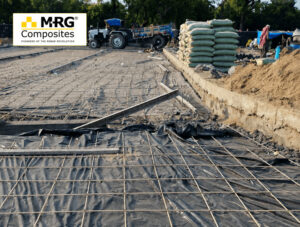
We partnered with AAJ BUILDCON for an RCC road construction project in Ahmedabad. We supplied GFRP Rebar to reinforce an urban road designed to handle heavy traffic and challenging environmental conditions.
Our corrosion-resistant reinforcement offered a suitable solution for the project’s exposure conditions. Its lightweight properties also helped simplify transportation and installation.
The project was completed ahead of schedule and within budget. It demonstrates how our GFRP Rebar can support road construction projects exposed to moisture, harsh weather and heavy traffic.
Read our project case study: RCC Road Construction Ahmedabad
Our In-House GFRP Rebar Testing Laboratory

At MRG Composites, we have an in-house testing laboratory to evaluate the quality and performance of our GFRP Rebar at different stages of production. Our facility allows us to check mechanical properties, bond performance, material composition and durability.
Our key testing capabilities include:
- Mechanical testing: Tensile strength, tensile modulus, elongation and shear strength.
- Bond testing: Pull-out bond and adhesion testing.
- Material analysis: Fibre content and resin distribution inspection.
- Durability testing: Water absorption and alkaline resistance.
- Dimensional inspection: Diameter, surface profile, weight and straightness checks.
We follow a quality control process that covers raw material inspection, production monitoring, mechanical testing and final dispatch approval. We also test every production batch before dispatch to maintain product consistency.
Through our in-house testing facilities and quality checks, we aim to provide engineers and contractors with reliable GFRP Rebar for infrastructure projects.
Explore our testing facilities: MRG Composites In-House Testing Laboratory