
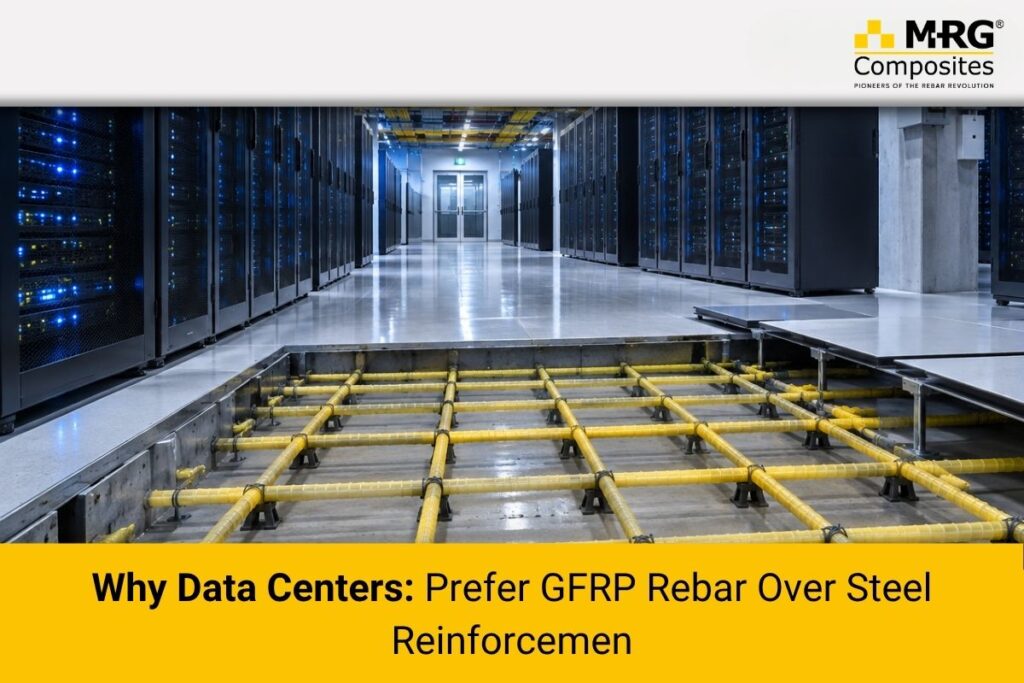
Data centers need reinforced concrete structures that remain reliable for years with minimal maintenance. Foundations, equipment slabs, floors, walls, cable trenches, and other concrete elements are exposed to demanding operating conditions. Even a small durability problem can lead to repair work, downtime, or disruption to critical infrastructure.
Steel reinforcement has been the standard choice for reinforced concrete for decades. However, project teams are increasingly evaluating alternatives such as Glass Fiber Reinforced Polymer (GFRP) rebar for applications where corrosion, weight, electrical conductivity, and long-term durability are important considerations. As data center construction accelerates, GFRP Rebar for data centers is becoming a key part of that evaluation.
So, why are data center projects considering GFRP Rebar over conventional steel?
The answer lies in the properties of the reinforcement itself.
What is GFRP Rebar?
GFRP Rebar is a composite reinforcement made by combining high-strength glass fibers with a polymer resin. Unlike steel, it does not contain metal and does not rust.
The reinforcement is designed to perform inside concrete while providing tensile strength without the corrosion concerns associated with conventional steel reinforcement.
For data center construction, this difference is important because many facilities are designed for long service life and continuous operation.
Why is Reinforcement Selection Important in Data Centers?
A data center is more than a typical commercial building. It houses sensitive electrical and electronic equipment, backup power systems, cooling infrastructure, servers, cables, and other critical systems.
Concrete structures within these facilities need to support heavy equipment and remain durable under demanding conditions.
Reinforcement selection affects several aspects of a project, including:
- Structural performance
- Concrete durability
- Construction handling
- Maintenance requirements
- Electrical properties
- Long-term lifecycle costs
- Resistance to environmental exposure
This is why engineers and project teams need to look beyond the initial material price when comparing reinforcement options and why interest in GFRP Rebar for data centers continues to grow among structural and electrical design teams.
1. GFRP Rebar Does Not Corrode Like Steel
Corrosion is one of the biggest concerns with steel-reinforced concrete.
When moisture and chlorides reach steel reinforcement, corrosion can begin. The corrosion products occupy more volume than the original steel. This creates internal pressure within the concrete and can eventually contribute to cracking, delamination, and spalling.
Repairing damaged reinforced concrete inside a working data center is not a simple task. Access to critical areas might be restricted, and maintenance work needs careful planning to avoid affecting operations.
GFRP reinforcement is not susceptible to steel-type corrosion. This makes it attractive for concrete structures exposed to moisture, chemicals, or other corrosive conditions.
For project teams looking at long-term durability, corrosion resistance is one of the strongest reasons to consider GFRP bars.
2. It Offers a Non-Conductive Reinforcement Option
Steel is electrically conductive because it is a metal. GFRP is different.
GFRP reinforcement is electrically non-conductive and non-magnetic. This property is useful in facilities where electromagnetic interference and electrical considerations need to be managed carefully.
Data centers contain extensive electrical infrastructure, including power distribution systems, transformers, generators, UPS systems, and large quantities of cabling.
Using a non-metallic reinforcement in selected concrete applications helps engineers avoid introducing conductive reinforcement where it is unnecessary or undesirable.
The decision still needs to be based on the specific application and engineering requirements. GFRP is not automatically the right reinforcement for every structural element.
3. Lower Reinforcement Weight Makes Handling Easier
A GFRP bar is significantly lighter than a comparable steel reinforcement bar.
This difference becomes noticeable during transportation and installation. Workers need to move reinforcement around the jobsite, place it within formwork, and tie reinforcement cages or mats before concrete placement.
Lower weight can make these activities easier and reduce the need for heavy lifting equipment for certain reinforcement operations.
For large data center projects, where reinforcement quantities can be substantial, easier handling can contribute to smoother site operations.
The benefit is especially relevant when reinforcement needs to be moved across large slabs or difficult-to-access areas.
4. GFRP Does Not Rust During Storage
Steel reinforcement needs proper storage and handling to control corrosion before installation.
GFRP does not have the same rusting concern. This gives contractors more flexibility when storing reinforcement at the project site.
It is still important to follow the manufacturer’s storage and handling instructions. Composite reinforcement has its own requirements, and improper handling can damage the bars before they are installed.
For large projects with phased construction schedules, the ability to store reinforcement without dealing with conventional steel rusting concerns can be useful.
5. High Tensile Strength Supports Demanding Applications
GFRP reinforcement has a high tensile strength compared with conventional steel reinforcement.
However, engineers should not compare reinforcement materials using tensile strength alone.
Steel and GFRP behave differently under load. Steel has a relatively high modulus of elasticity and yields before failure. GFRP behaves as a linear-elastic material until failure and does not yield in the same way.
This means structural design with GFRP needs to account for properties such as:
- Tensile strength
- Elastic modulus
- Bar diameter
- Bond characteristics
- Development length
- Deflection
- Crack width
- Environmental exposure
- Anchorage and detailing requirements
For this reason, GFRP should be selected and designed according to the applicable engineering standards rather than treated as a direct one-for-one replacement for steel.
6. Long-Term Maintenance is an Important Consideration
The initial reinforcement cost is only one part of a data center project’s overall cost.
Owners also need to think about maintenance, repairs, access, labor, downtime, and the expected service life of concrete structures.
Steel reinforcement that corrodes inside concrete can create maintenance problems over time, particularly in aggressive environments.
GFRP’s resistance to corrosion helps address one of the major causes of deterioration associated with steel-reinforced concrete.
For data center owners planning for long-term operation, this lifecycle perspective is often more useful than comparing the purchase price of reinforcement alone.
7. GFRP Can Be Useful in Electrically Sensitive Areas
Data centers rely heavily on electrical systems. Some parts of the facility require careful consideration of electromagnetic and electrical behavior.
Because GFRP is non-metallic, it does not behave like steel reinforcement in electromagnetic environments.
This characteristic makes it worth evaluating for applications such as equipment foundations, slabs, floors, and other areas where engineers want to avoid unnecessary metallic reinforcement.
The actual reinforcement specification should always come from the structural and electrical design teams based on the requirements of the facility.
Where Can GFRP Rebar Be Used in Data Centers?
GFRP is suitable for evaluation in several concrete applications within data center projects. The following are among the most common use cases for GFRP Rebar for data centers:
Equipment Pads and Foundations Heavy equipment requires stable and durable concrete support. GFRP reinforcement is an option where corrosion resistance and non-metallic reinforcement are valuable.
Concrete Slabs Large slabs can contain substantial amounts of reinforcement. The lower weight of GFRP can simplify handling during installation.
Cable Trenches Cable infrastructure is a critical part of data center construction. GFRP is worth considering for reinforced concrete trenches where non-conductive reinforcement is beneficial.
Equipment Rooms Concrete structures around electrical and mechanical equipment need to withstand long-term service conditions. GFRP provides an alternative to conventional steel reinforcement for suitable applications.
Exterior Concrete Structures Where concrete is exposed to moisture or aggressive environmental conditions, corrosion-resistant reinforcement becomes more important.
The final application should always be determined through structural design and project specifications.
GFRP Rebar vs. Steel for Data Centers: Key Factors Engineers Should Consider
When selecting reinforcement for a data center, engineers need to consider more than tensile strength. The operating environment, durability requirements, electrical infrastructure, installation process, and expected service life all influence the right reinforcement choice.
GFRP Rebar offers several properties that make it particularly well suited to data center construction. Its corrosion resistance helps protect concrete structures from reinforcement-related deterioration, while its lightweight and non-metallic composition offers practical advantages during construction and around electrically sensitive infrastructure.
| Factor | GFRP Rebar | Steel Rebar |
| Corrosion resistance | Excellent | Requires protection in corrosive environments |
| Weight | Lightweight | Heavy |
| Electrical conductivity | Non-conductive | Conductive |
| Magnetic properties | Non-magnetic | Magnetic |
| Tensile strength | High | High |
| Yielding behavior | Linear-elastic until failure | Yields before failure |
| Storage | No steel-type rusting | Requires corrosion control |
| Handling | Easier due to lower weight | Requires more lifting effort |
| Design approach | Requires GFRP-specific design | Conventional steel design |
For data center projects, these characteristics make GFRP a strong option for applications where long-term durability, reduced reinforcement weight, and non-conductive construction materials are important.
What Should Data Center Project Teams Check Before Selecting GFRP?
Before specifying GFRP reinforcement, engineers and procurement teams should review several points.
Check the Design Requirements Confirm where GFRP is appropriate within the structural design. Not every concrete element needs the same reinforcement solution.
Review Material Properties Ask for technical data covering tensile strength, elastic modulus, bond characteristics, bar dimensions, and other relevant properties.
Confirm Applicable Standards The reinforcement should comply with the standards and specifications required for the project. Engineers should also use an appropriate GFRP design methodology.
Consider Installation GFRP is lighter than steel, but it needs proper handling. Bars should not be bent or modified on site unless the product and design specifically allow it.
Evaluate Lifecycle Value Look beyond the initial reinforcement cost. Consider durability, maintenance, handling, labor, and the expected service life of the structure.
Work With an Experienced Manufacturer Quality and consistency matter when reinforcement is being used in mission-critical construction. Working with an experienced GFRP Rebar manufacturer in India gives project teams access to product information and technical support during material selection and procurement.
Why GFRP Rebar is a Strong Choice for Data Center Construction
Data centers demand materials that support reliable, long-term infrastructure. GFRP Rebar aligns well with these requirements through its combination of corrosion resistance, high tensile strength, lightweight construction, and non-metallic properties.
Its resistance to corrosion helps reduce concerns associated with reinforcement deterioration in concrete. The lower weight simplifies transportation and handling on large construction sites. Its non-conductive and non-magnetic characteristics also make it particularly relevant for selected areas around sensitive electrical and electronic infrastructure.
For these reasons, project teams are increasingly evaluating GFRP reinforcement for applications such as equipment foundations, slabs, cable trenches, equipment rooms, and other reinforced concrete structures.
The right application should be established during structural design, with the reinforcement specified according to project requirements and applicable GFRP design standards.

Build More Durable Data Centers with GFRP Rebar
Final Thoughts
Data centers are designed around reliability. The concrete structures supporting critical equipment need to perform for years while keeping maintenance demands under control.
GFRP Rebar for data centers offers several properties that align well with these requirements. It resists corrosion, weighs less than steel, does not conduct electricity, and provides high tensile strength.
For structural engineers, developers, contractors, and procurement teams, these benefits make GFRP worth considering during the early design and material-selection stages.
The key is to choose GFRP based on the project’s structural needs. When properly designed and specified, GFRP offers a practical reinforcement solution for data centers that need durability and non-metallic reinforcement.