
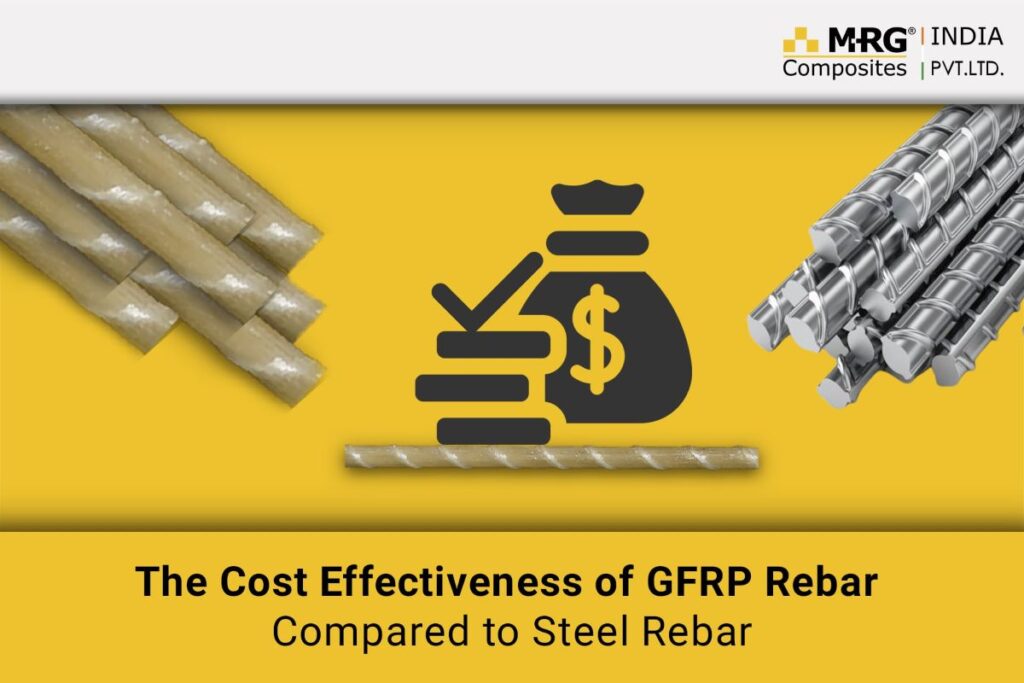
Choosing reinforcement isn’t only about the price per bar. Total cost also includes transportation, handling, installation, maintenance and repairs across the structure’s service life.
GFRP rebar can save money in several of those areas because it’s lightweight and doesn’t suffer electrochemical corrosion.
But is GFRP actually more cost-effective than steel? It depends on the project, material prices and long-term requirements. Let’s look at the costs that matter.
What Makes GFRP Rebar Cost-Effective?
GFRP rebar can trim costs at different stages of a construction project.
Its low weight simplifies transportation and handling. Its corrosion resistance also lowers the risk of corrosion-related repairs in aggressive environments.
So don’t stop at the purchase price when you compare costs.
Initial Cost: GFRP Rebar vs Steel Rebar
Reinforcement price takes a big slice of any project budget.
Steel rebar can cost more or less upfront depending on market conditions, bar size, quantity and location. GFRP pricing also shifts with product specifications, quantity and project requirements.
Want to know what drives material pricing? Our guide to GFRP bar price in India breaks it down.
Still, a price per metre or per kilogram doesn’t tell the whole story. A better comparison looks at total installed cost and expected maintenance.
Lower Transportation and Handling Costs
GFRP rebar weighs far less than steel.
That makes loading, unloading, transporting and moving the bars around the site easier. Depending on the project, the lower weight can cut handling effort and transportation needs.
These savings matter more on projects with large reinforcement quantities or difficult site access.
Installation and Labor Costs
Crews cut GFRP with suitable tools, and its low weight makes it easier to handle.
Workers move and position the bars with less lifting effort than heavy steel demands.
Installation costs still depend on the design, reinforcement layout, bar sizes and site conditions. Don’t assume GFRP lowers labor costs on every project.
Reduced Corrosion-Related Maintenance
One of the biggest cost questions comes after construction ends.
Steel corrodes when moisture and chlorides reach it under the right conditions. That corrosion can crack the concrete, delaminate it and spall it, and all of that leads to repair bills.
GFRP rebar doesn’t undergo the electrochemical corrosion that affects steel.
On structures exposed to moisture, chlorides or other aggressive environments, that resistance lowers the risk of corrosion damage and the repair costs that follow.
Long-Term Cost and Service Life
GFRP’s economic value grows when a project targets long-term performance.
Reinforcement that limits corrosion-related deterioration can reduce future repair needs. That matters most for structures such as bridges, roads, marine structures, parking facilities and other concrete applications in aggressive environments.
Actual lifecycle cost depends on several factors:
- Initial reinforcement cost
- Transportation
- Installation
- Concrete design
- Environmental exposure
- Maintenance requirements
- Expected service life
- Repair costs
So evaluate GFRP on total lifecycle cost, not just the initial material price.
GFRP Rebar vs Steel Rebar: Cost Comparison
For a broader look at the two materials, read our complete guide to GFRP rebar vs steel rebar.
| Cost Factor | GFRP Rebar | Steel Rebar |
| Initial material price | Depends on project and market | Depends on project and market |
| Transportation | Lower weight can simplify transportation | Higher weight |
| Handling | Easier because of lower weight | Requires more handling effort |
| Installation | Easier to handle | Familiar and widely used |
| Corrosion | Resists electrochemical corrosion | Can corrode under suitable exposure conditions |
| Maintenance | Can potentially reduce corrosion-related maintenance | May require corrosion-related repairs |
| Lifecycle cost | Depends on project conditions | Depends on project conditions |
This comparison shows why the cheapest reinforcement at purchase isn’t always the cheapest over the project’s full lifecycle.
What Affects the Cost of GFRP Rebar?
Several factors shape the final cost of GFRP rebar:
- Bar diameter
- Required quantity
- Bar length and shape
- Project specifications
- Custom bending requirements
- Transportation distance
- Order volume
- Installation requirements
For an accurate comparison, evaluate GFRP and steel against the same reinforcement requirements and project conditions.
Is GFRP Rebar Cost-Effective for Every Project?
Not necessarily.
Cost-effectiveness depends on the project environment, reinforcement requirements, local material prices, transportation, installation and expected maintenance.
GFRP becomes especially relevant when corrosion resistance, low weight and long-term durability rank high on the priority list.
Engineers and contractors should compare both initial and lifecycle costs before they pick a reinforcement material.
Conclusion
You can’t judge the cost-effectiveness of GFRP rebar by comparing its purchase price with steel alone.
Its lower weight offers advantages in transportation and handling, and its resistance to electrochemical corrosion helps cut corrosion-related maintenance in suitable environments.
When long-term durability matters, weigh material, installation, maintenance and lifecycle costs together. That gives you a far more complete picture of how GFRP and steel stack up.
For projects where lifecycle cost and long-term durability matter, choosing the right GFRP rebar manufacturer is also important.
MRG Composites is one of the leading GFRP rebar manufacturers in India, supplying GFRP reinforcement for construction and infrastructure applications where corrosion resistance and long-term performance are key considerations.