
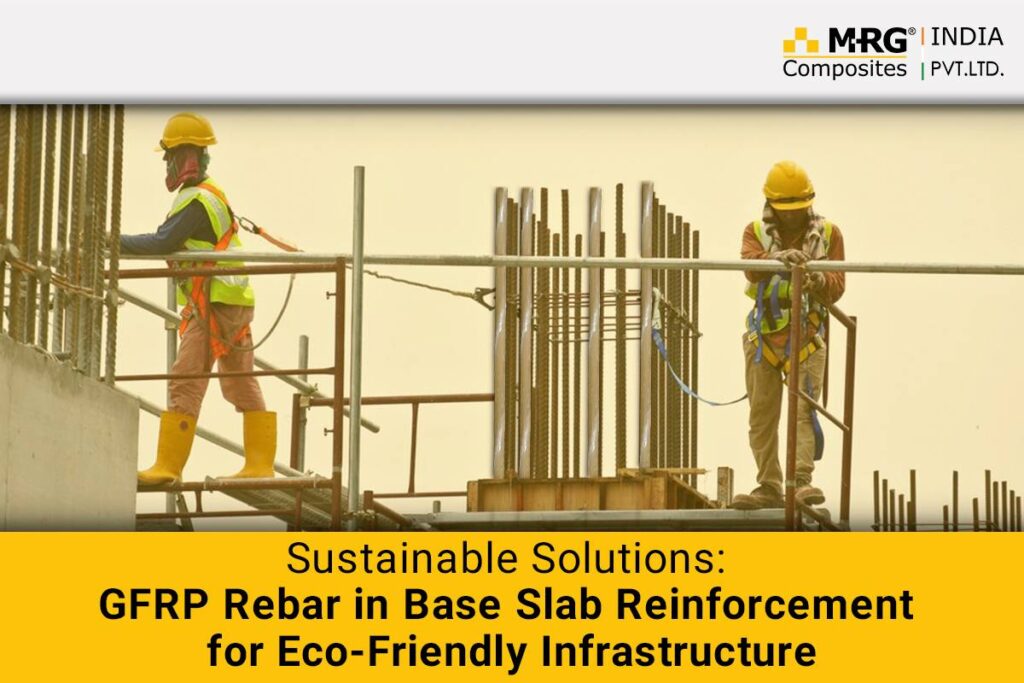
Sustainable Solutions: GFRP Rebar in Base Slab Reinforcement for Eco-Friendly Infrastructure

Base slab faces several challenges such as durability. Traditional steel rebar is not compatible with water, moisture, chloride or chemicals. It requires regular maintenance and increases costs. GFRP Rebar – Glass Fiber Reinforced Polymer is a modern base slab construction material. It is stronge, lighter, corrosion resistant, durable, and cost-effective base slab construction material.
MRG Composites is one of India’s leading GFRP rebar manufacturers with over 17+ years of industry experience and more than 5000+ completed global projects. The company has supplied 5000+ metric tons of GFRP rebar worldwide, supporting large infrastructure, industrial and commercial developments. MRG’s GFRP rebar is known for being around two times stronger than steel while weighing only one-quarter of traditional reinforcement bars. With ISO 9001:2015 certification and a presence across multiple countries, MRG provides engineered composite reinforcement designed for modern construction requirements.
What Is GFRP Rebar and Why It Matters
GFRP Rebar is a modern composites material. It consists of Glass Fiber and Polymer resin. Glass fiber protects polymer resin and makes ti more stronger.
Key technical attributes include:
- High tensile strength exceeding 1000 MPa.
- Lightweight composition,It is ¼ lighter than traditional steel rebar.
- It is a corrosion resistant base slab construction material.
- Low thermal expansion, minimizing temperature-driven cracking.
- Non-conductive and non-magnetic, suitable for sensitive environments.
These properties significantly enhance the lifespan and reliability of base slabs.
Why Base Slab Reinforcement Needs Better Materials
Base slab is a foundational structure layer, It is used in warehousing, manufacturing, heavy machinery, parking and logistics. When steel rebar corrodes it expands and creates internal pressure. It weakesn the slab and increases long-term maintenance costs.
GFRP solves these concerns in several ways:
- No rust formation, reducing cracking and spalling.
- Lower dead load, enabling lighter structures and optimized concrete consumption.
- Better handling efficiency, reducing fatigue and installation time for workers.
- Compatibility with harsh environmental conditions, extending service life.
For projects exposed to moisture, chemicals, or temperature variations, GFRP ensures superior performance and reduced lifecycle cost.
Best Practices When Using GFRP Rebar in Base Slabs
To achieve maximum structural performance, engineers and contractors should follow these best practices while designing and installing GFRP rebar in base slabs.
1. Design According to GFRP Properties
GFRP has a lower modulus of elasticity compared to steel. Engineers must calculate deflection, crack control, and serviceability using design guidelines such as ACI 440 and the Indian standards IS 18255 and IS 18256. Often, slab design may require modified bar spacing or increased reinforcement quantity to match stiffness requirements.
2. Maintain Proper Bar Spacing and Concrete Cover
Uniform bar spacing ensures optimal load distribution across the slab. Adequate concrete cover is essential to protect reinforcement and maintain bond strength. Engineers should refer to the recommended exposure classes and cover requirements suitable for the project environment.
3. Use Prefabricated Bends and Couplers
GFRP cannot be bent at the job site. Hooks, bends, and stirrups should be requested as prefabricated shapes from the manufacturer. Contractors may also use specially designed couplers to join bars safely. This ensures structural integrity and avoids fibre damage.
4. Follow Safe Handling and Storage Methods
Although GFRP is strong in tension, its surface can be damaged by abrasive handling. Contractors should:
- Store bars under shade to avoid extended UV exposure.
- Avoid dragging bars on rough surfaces.
- Use proper lifting equipment or team lifting for long bars.
5. Ensure Correct Concrete Placement
Concrete should be placed with controlled vibration to prevent displacement of lightweight GFRP bars. Workable mixes improve compaction, heighten bond performance, and maintain cover. During placement, workers should monitor bar movement to maintain designed spacing.
6. Conform to Standards and Testing
GFRP Rebar must compy with national and international standards. GFRP Rebar must match testing standards for tensile strength and bond strength.
Practical Benefits on the Construction Site
GFRP Rebar makes easy base slab construction workflow by
- Faster installation: GFRP Rebar’s light weight nature makes it faster installation.
- Less equipment dependence: Contractors often eliminate the need for cranes or heavy lifting tools, lowering site congestion.
- Better safety: Non-conductive bars reduce electrical hazards, especially in industrial flooring or projects with sensitive equipment.
- Cleaner reinforcement: Because GFRP does not rust, project sites remain cleaner without rust-related stains or waste.
These benefits significantly reduce installation time and improve overall construction efficiency.
Applications Beyond Base Slabs
The advantages of GFRP extend across diverse applications where corrosion resistance and durability are essential:
- Road and highway base layers
- Coastal construction zones
- Bridge decks and elevated roads
- Industrial and heavy-load flooring
- Water tanks, retaining walls, foundations
- Parking structures and precast components
- Chemical processing areas
These wide-ranging applications demonstrate the versatility and long-term value of GFRP rebar.
Conclusion
Base slab construction requires stronger, corrosion resistant, durable, and cost-effective construction material. GFRP Rebar is a modern construction material and fullfills the above requirements. MRG Composites is a leading GFRP Rebar manufacturers in India. MRG GFRP Rebars follow best practise in design, handling, quality standards, and installation.