
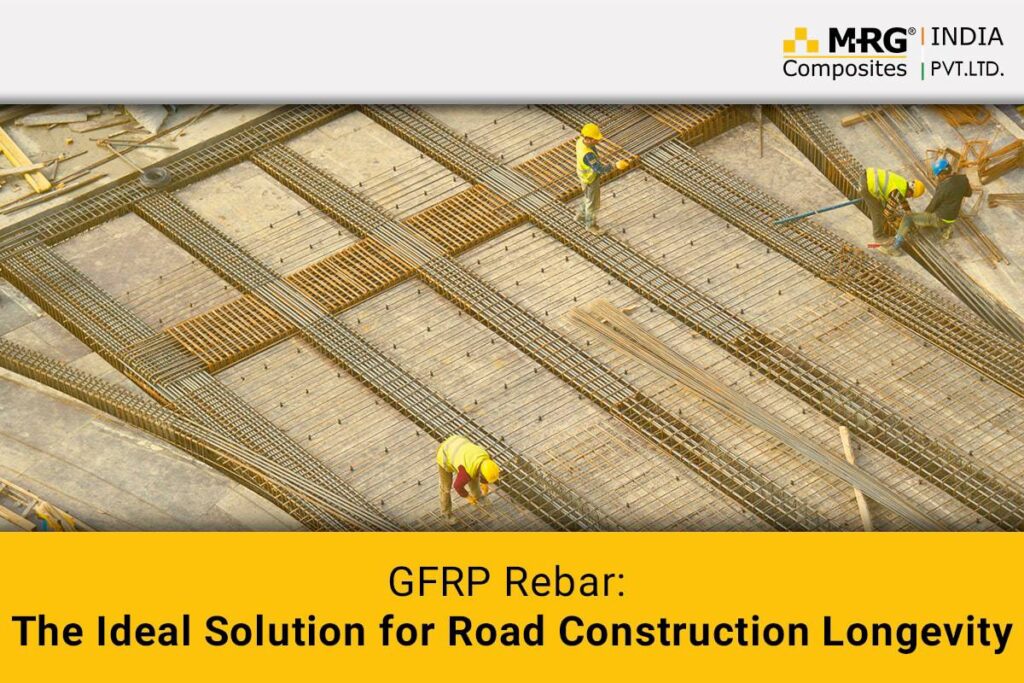
Concrete roads are designed to perform for decades, but reinforcement durability plays an important role in how well they hold up over time.
Water, chlorides, salts, chemicals, and repeated environmental exposure can affect reinforcement. For steel, corrosion is one of the biggest long-term durability concerns.
When water and chlorides reach steel reinforcement, corrosion can begin. The resulting rust takes up more space than the original steel and puts pressure on the surrounding concrete. Over time, this can contribute to cracking, delamination, and spalling.
For roads and highways, these problems also mean more maintenance, lane closures, traffic disruption, and higher lifecycle costs.
This is where GFRP rebar for road longevity becomes relevant.
Glass Fibre Reinforced Polymer (GFRP) rebar is a non-metallic reinforcement material made from glass fibres embedded in a polymer resin. It offers high tensile strength, low weight, and strong resistance to corrosion.
These properties make GFRP relevant for concrete roads and infrastructure exposed to moisture, salts, chlorides, and other harsh conditions.
GFRP is not a direct one-to-one replacement for steel. It has different mechanical properties and needs to be considered through appropriate engineering design.
So, how does GFRP contribute to longer-lasting roads? And where does it make the most sense?
Why Road Longevity Depends on Reinforcement Durability
The service life of a concrete road depends on more than pavement thickness or concrete mix.
Reinforcement, drainage, joints, environmental exposure, construction quality, curing, and maintenance all affect long-term performance.
Road infrastructure may face exposure to:
- Rainwater and groundwater
- Chlorides and road salts
- Saline soil
- Coastal air and salt spray
- Industrial chemicals
- Repeated wet and dry cycles
- Waterlogging and poor drainage
When these conditions allow corrosion to reach steel reinforcement, the reinforcement itself can contribute to concrete deterioration.
For long-life infrastructure, engineers therefore look at more than initial strength. Corrosion resistance and expected service performance also matter.
How Does GFRP Rebar Improve Concrete Road Durability?
GFRP rebar is made from glass fibres embedded in a polymer resin. Unlike steel, it is non-metallic and does not rust.
This makes it particularly relevant for reinforced concrete exposed to moisture, chlorides, salts, and other aggressive environments.
1. Corrosion Resistance Helps Protect Concrete
One of the biggest durability benefits of GFRP rebar is its resistance to corrosion.
Steel reinforcement can lose part of its cross-section as corrosion develops. Rust also expands and puts pressure on the surrounding concrete. Over time, this can contribute to cracking, spalling, and other pavement damage.
GFRP does not rust like steel because it contains no steel. This makes it a strong option for roads exposed to moisture, road salts, saline conditions, and chemicals.
GFRP does not prevent every type of pavement damage. Long-lasting roads still require proper concrete mix design, adequate cover, drainage, joints, curing, and construction practices.
The key benefit is simple: GFRP rebar does not become a source of rust-related damage inside the concrete.
2. GFRP Supports Long-Term Performance in Aggressive Environments
Roads in coastal areas, ports, industrial zones, and locations with aggressive groundwater face tougher durability conditions.
In these environments, corrosion-resistant reinforcement becomes especially valuable.
GFRP reinforcement resists moisture, salts, and many harsh environments. This makes GFRP bars suitable for projects where corrosion of steel is a major concern.
For infrastructure owners, the focus shifts from dealing with corrosion-related damage later to selecting reinforcement suited to the exposure conditions from the beginning.
3. Lower Weight Simplifies Transportation and Handling
GFRP rebar is significantly lighter than steel.
MRG’s published product information lists GFRP rebar at roughly one-quarter the weight of steel reinforcement.
This can make a difference on large road projects where reinforcement needs to be transported, unloaded, moved across work zones, positioned, and stored before concrete placement.
The lower weight also makes bundles easier for site crews to handle.
NHAI sustainability reporting also highlights easier handling of GFRP reinforcement compared with conventional steel.
4. High Tensile Strength Without Steel’s Weight
GFRP combines high tensile strength with low density.
At MRG Composites, our GFRP reinforcement offers tensile strength above 1000 MPa.
However, tensile strength should not be used alone to determine reinforcement quantities or bar sizes.
GFRP behaves differently from steel because it has a different stiffness and strain response. Road and pavement designs should account for these properties and follow the requirements of the relevant design standards.
This distinction is important when evaluating GFRP rebar vs steel rebar for road projects.
GFRP Rebar vs Steel Rebar: Which Is More Durable?
The durability comparison is not based on tensile strength alone.
| Property | Steel Rebar | GFRP Rebar |
| Corrosion resistance | Vulnerable to corrosion | Resistant to corrosion |
| Density | High | Much lower |
| Handling | Heavier | Lightweight |
| Electrical conductivity | Conductive | Non-conductive |
| Tensile strength | High | High |
| Modulus of elasticity | Higher | Lower than steel |
| Aggressive environments | Corrosion protection is important | No rusting of reinforcement |
| Design approach | Conventional steel design | FRP-specific design considerations |
For road longevity, one of the most important differences is corrosion behaviour.
Where corrosion is a major concern, GFRP provides an important durability advantage.
The right reinforcement choice should also consider the project’s structural requirements, environmental exposure, construction method, applicable standards, and expected service conditions.
Where Does GFRP Reinforcement Make Sense in Road Infrastructure?
GFRP is especially useful for road projects where moisture, salts, or other harsh conditions could accelerate steel corrosion.
Common applications include:
Concrete Pavement
Concrete pavement exposed to water, salts, and aggressive environments requires careful consideration of reinforcement durability.
GFRP reinforcement provides a corrosion-resistant alternative for projects where corrosion of steel is a major concern.
Bridge Decks and Approach Slabs
Bridge decks are exposed to rain, moisture, and, in some regions, chlorides and de-icing salts.
GFRP’s corrosion resistance makes it relevant for these applications.
Coastal Roads
Salt-laden air, saline groundwater, and seawater exposure create demanding durability conditions.
For coastal infrastructure, corrosion-resistant reinforcement becomes especially valuable.
Port and Industrial Roads
Ports and industrial facilities can expose concrete infrastructure to salts, chemicals, moisture, and heavy traffic.
GFRP reinforcement is suited to applications where corrosion resistance is a priority.
Flyovers, Ramps, and Elevated Road Structures
Where reinforcement is difficult or expensive to repair after construction, selecting a corrosion-resistant material can support long-term durability planning.
Drainage and Related Infrastructure
Road drainage structures frequently remain in contact with water.
GFRP can be considered where corrosion resistance is an important design requirement.
How GFRP Can Help Extend Concrete Road Service Life
It is important to understand what GFRP does and does not do.
GFRP does not prevent every form of pavement deterioration.
Instead, it addresses one significant durability risk: corrosion of metallic reinforcement.
A long-lasting concrete road still depends on:
- Appropriate pavement design
- Correct reinforcement design
- Suitable concrete quality
- Adequate cover
- Proper drainage
- Correct joint design
- Good curing
- Proper reinforcement placement
- Construction quality
- Appropriate maintenance
When these factors are properly managed, corrosion-resistant reinforcement becomes part of a broader long-term durability strategy.
For environments where steel corrosion is a significant concern, GFRP offers a strong answer.
Does GFRP Rebar Last Longer Than Steel?
GFRP and steel should not be compared using one universal service-life number.
Actual performance depends on factors such as environmental exposure, concrete quality, design, installation, temperature, loading, manufacturing quality, material properties, and maintenance.
What distinguishes GFRP is its resistance to corrosion.
Steel reinforcement needs protection against corrosion through factors such as concrete quality, adequate cover, coatings, or other durability measures, depending on the project.
GFRP removes the steel-rusting mechanism from the reinforcement itself.
This is one of the main reasons GFRP is being considered for long-life infrastructure.
How Should Engineers Design With GFRP Rebar?
GFRP should be designed as a composite reinforcement material rather than treated as steel with a different surface.
Its mechanical properties are different from steel, so engineers should use the relevant GFRP design provisions and verified manufacturer data.
Important considerations include:
Reinforcement Diameter and Spacing
Bar diameter and spacing should be determined from the engineering design rather than by simply matching an existing steel reinforcement schedule.
Concrete Cover
Adequate concrete cover remains important for durability and reinforcement protection.
Bond With Concrete
GFRP bars use a surface profile designed to develop bond with concrete. MRG manufactures ribbed, surface-profiled GFRP reinforcement for concrete applications.
Development and Anchorage
GFRP has different mechanical behaviour from steel, so development and anchorage need to be addressed according to the applicable design provisions.
Pavement Joints
Joint detailing deserves particular attention in concrete pavement.
Engineers should consider how reinforcement interacts with contraction, construction, and expansion joints, and should follow the project-specific pavement design.
Temperature and Elastic Behaviour
GFRP has a lower modulus of elasticity than steel and behaves differently under load.
This difference should be included in design calculations rather than assuming steel and GFRP behave identically.
Field Bending
GFRP bars should not be bent on site like conventional steel bars.
MRG states that bent or curved GFRP elements are supplied as prefabricated components according to the required configuration.
These considerations make engineering guidance and manufacturer documentation important before construction begins.
How Should GFRP Rebar Be Handled on a Road Project?
GFRP is lightweight, but proper site handling is still important.
Contractors should:
- Store bars in a suitable protected area
- Prevent unnecessary physical damage
- Follow manufacturer handling instructions
- Use appropriate cutting equipment
- Avoid unauthorised field bending
- Maintain the designed spacing during placement
- Ensure reinforcement remains correctly positioned during concrete placement
- Check material identification and batch documentation
The goal is simple: the reinforcement installed in the pavement should match the material and configuration specified in the design.
Proper documentation also helps engineers and procurement teams verify compliance, testing, traceability, and project approval requirements.
For this reason, engineers should review the applicable standards, project specifications, manufacturer’s technical data, and required test documentation before material approval.
What Standards Apply to GFRP Reinforcement in Indian Road Projects?
For Indian infrastructure projects, standards and project specifications are important parts of material selection.
MRG Composites states that its GFRP reinforcement is manufactured in accordance with:
- IS 18255:2023 — Fibre-Reinforced Polymer (FRP) Rebars for Concrete Reinforcement: Methods of Test
- IS 18256:2023 — Solid Round GFRP Rebars for Concrete Reinforcement: Specification
- IRC:137-2022 — Guidelines on the Use of Fibre-Reinforced Polymer Bars in Road Projects, issued by the Indian Roads Congress (IRC)
- ISO 9001:2015 — Quality management system certification
MRG also holds BIS (Bureau of Indian Standards) Licence CM/L-7600217414 for GFRP bars.
For engineers and procurement teams, this documentation matters because reinforcement selection is not only about performance claims. Material compliance, testing, traceability, and project approval requirements also need to be established.
Why NHAI’s Recognition of GFRP Matters
GFRP is gaining attention in Indian road infrastructure for reasons beyond manufacturer claims.
NHAI’s Sustainability Report for FY 2023–24 highlights GFRP rebars for their corrosion resistance and easier handling compared with conventional steel.
At MRG Composites, we have also been involved in NHAI infrastructure projects. We completed the Karala–Kanjhawala Road project in Delhi.
For road project teams, this shows that GFRP is becoming part of India’s growing focus on durable and efficient infrastructure solutions.
Why MRG Composites Is Relevant for Road Reinforcement Projects
For road infrastructure, selecting the material is only part of the decision. The manufacturer also needs to provide reliable technical documentation and consistent product quality.
MRG Composites is India’s first GFRP rebar manufacturer to hold a BIS licence, CM/L-7600217414, according to its published certification information.
The company states that its GFRP bars are manufactured according to IS 18255:2023 and IS 18256:2023, and that it operates under ISO 9001:2015 certification.
For engineers, contractors, and procurement teams, useful supplier documentation includes:
- BIS licence
- Product specification
- Material test reports
- Applicable standards
- Quality certification
- Technical datasheets
- Diameter and weight information
- Surface/bond information
- Project references
- Installation guidance
These documents help the project team evaluate whether the reinforcement is appropriate for the specific road application.
When Should You Consider GFRP for Road Longevity?
GFRP deserves consideration when several of the following conditions apply:
- Corrosion is a significant durability concern
- The road is exposed to chlorides or saline conditions
- The project is located near the coast
- Water exposure is persistent
- The structure is difficult or expensive to repair
- Long-term maintenance disruption is a concern
- Lightweight reinforcement would simplify handling
- Non-conductive reinforcement is required
- The project specification permits GFRP reinforcement
- Appropriate design and technical documentation are available
How to Extend Concrete Road Service Life
Reinforcement is only one part of road durability.
For a long-lasting concrete road, project teams should consider the complete system:
Design → Materials → Reinforcement → Drainage → Joints → Construction → Curing → Maintenance
GFRP addresses the reinforcement component by removing the corrosion mechanism associated with steel.
When combined with appropriate pavement design, concrete quality, drainage, joint detailing, and construction practices, corrosion-resistant reinforcement can form part of a broader strategy for improving infrastructure durability.
Final Takeaway: GFRP Rebar and the Future of Long-Lasting Roads
Road longevity is ultimately about controlling the causes of deterioration.
Steel reinforcement has been used successfully for decades, but corrosion remains a major durability challenge in environments where moisture, chlorides, salts, and chemicals reach the reinforcement.
GFRP offers a different approach.
It combines high tensile strength with low weight and corrosion resistance. For concrete roads, bridge decks, coastal infrastructure, industrial roads, and other applications where reinforcement durability is critical, these properties make GFRP worth evaluating.
The decision should still be engineering-led.
GFRP is not a universal one-to-one replacement for steel. Its different modulus, strain behaviour, anchorage requirements, handling requirements, and design considerations need to be accounted for.
For civil engineers, contractors, infrastructure consultants, and public works teams, the real value of GFRP rebar for road longevity lies in its ability to address corrosion at the reinforcement level while supporting a broader long-term durability strategy.
When the project environment demands corrosion-resistant reinforcement, GFRP deserves serious consideration.
Frequently Asked Questions
Does GFRP rebar improve road durability?
Yes. GFRP rebar does not rust like steel, so it removes corrosion of the reinforcement as a potential source of rust-induced concrete deterioration. Its effectiveness still depends on proper pavement design, concrete quality, reinforcement placement, drainage, joints, and construction practices.
Why use GFRP rebar for long-lasting roads?
GFRP is particularly useful where corrosion is a major durability concern. It is resistant to corrosion, lightweight, non-conductive, and has high tensile strength. These properties make it relevant for concrete infrastructure exposed to water, salts, chlorides, and aggressive environments.
How does GFRP rebar prevent corrosion in roads?
GFRP is made from glass fibres embedded in a polymer resin rather than steel. Since it does not contain conventional steel reinforcement, it does not rust through the electrochemical corrosion process associated with steel.
Can GFRP replace steel rebar in concrete roads?
GFRP can be used as an alternative reinforcement material in suitable concrete infrastructure applications, but it should not be treated as a direct one-for-one replacement. Engineers need to design with the specific mechanical properties and applicable GFRP design provisions.
What should I check before selecting GFRP rebar for a road project?
Review the project design requirements, applicable standards, environmental exposure, reinforcement diameter and spacing, concrete cover, joint details, anchorage requirements, manufacturer’s technical data, test reports, quality certifications, and project-specific approval requirements.
Is MRG Composites BIS certified for GFRP rebar?
MRG Composites states that it holds BIS Licence CM/L-7600217414 for GFRP bars and manufactures according to IS 18255:2023 and IS 18256:2023. It also states that it is ISO 9001:2015 certified.