
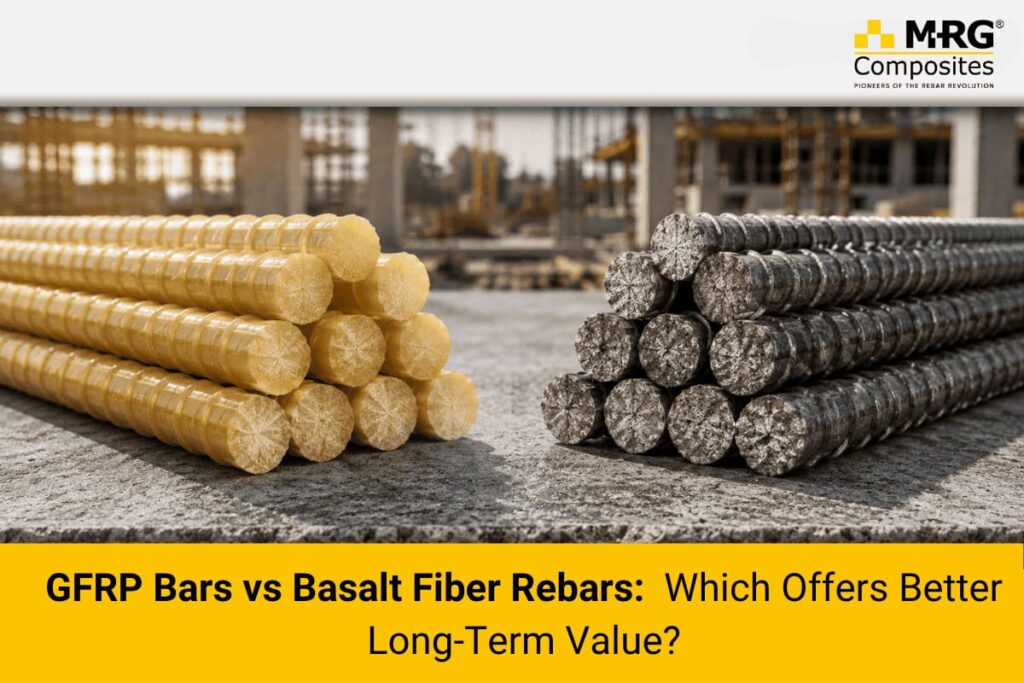
If you’ve spent any time researching corrosion-resistant reinforcement, you’ve probably hit the same fork in the road: glass fibre or basalt fibre? Both promise the same headline benefits — no rust, no chloride attack, decades of maintenance-free service. Both look similar in a supplier’s catalogue photo. And both come with confident marketing claiming the other one is the compromise choice.
The honest answer is less dramatic than either camp likes to admit: the two materials are closer cousins than rivals. Where they actually differ is in raw strength, alkali resistance, cost, and — for anyone building in India specifically — how easy the material is to source, certify, and get approved on a real project. Let’s go through it property by property.
1. GFRP and Basalt Rebar Are Made the Same Way — With a Different Fibre
Both GFRP (Glass Fibre Reinforced Polymer) and BFRP (Basalt Fibre Reinforced Polymer) are pultruded composite bars: continuous mineral fibres pulled through a resin bath and cured into a rigid, ribbed or sand-coated rod. The manufacturing process is nearly identical.
What changes is the fibre itself. GFRP uses glass fibre, drawn from melted silica sand and other minerals at around 1,200°C. BFRP uses fibre drawn from melted basalt rock — a natural volcanic stone — at a higher temperature, giving the fibre its distinctive golden-brown colour.
You can explore our GFRP Bars and GFRP Mesh range, manufactured as per IS 18256:2023 standards. As trusted GFRP rebar manufacturers in India, we deliver durable, corrosion-resistant reinforcement solutions for modern construction.
2. Strength and Stiffness: Basalt Has the Edge on Paper
Basalt fibre generally has higher tensile strength when compared directly with GFRP. Basalt rebar typically ranges between 800–1,500 MPa, while standard E-glass GFRP rebar is usually around 480–1,000 MPa, depending on the fibre type and resin system.
This strength difference is real, but it does not always decide the best choice for concrete reinforcement.
Both BFRP and GFRP have a similar elastic modulus, usually around 40–65 GPa, compared with steel at about 200 GPa. Because of this, most concrete designs are controlled by deflection and crack-width limits rather than the unused tensile strength of the bar.
Basalt fibre offers an advantage in projects where higher tensile capacity is critical. However, for common applications like slabs, foundations, and precast elements, factors such as cost, availability, durability, and project requirements often matter more than strength alone.
3. Alkali Resistance: The Real Point of Difference
Concrete’s pore water is highly alkaline, with a pH of around 12–13. Under long-term exposure, standard E-glass fibres may slowly degrade due to alkali attack, a process known as hydrolysis.
Basalt fibre has better natural resistance to alkaline conditions than untreated E-glass. Some accelerated ageing studies show that BFRP retains its tensile properties more effectively during prolonged exposure.
However, not all GFRP is the same. ECR-glass and AR-glass formulations are designed to improve alkali resistance and reduce this durability gap.
When combined with high-quality vinyl ester or epoxy resin systems, GFRP performance becomes much closer to basalt fibre.
The key point for engineers is to check the actual fibre type and resin system. The material specification matters more than simply choosing GFRP or BFRP.
If alkali resistance is the deciding factor for your project, ask any supplier — basalt or GFRP — for accelerated ageing test data on their specific product, not a generic industry figure. Fibre chemistry varies enough between manufacturers that the numbers you find online won’t always match what’s actually in the bar you receive.
4. Weight, Thermal Behaviour, and Handling
Both materials are similar in weight. GFRP and basalt rebar have around one-quarter the density of steel, which makes composite reinforcement easier to handle and transport.
The lightweight advantage applies equally to both materials, including lighter bundles, faster installation, and reduced lifting requirements on site.
Basalt fibre performs better at higher temperatures and has a thermal expansion coefficient closer to concrete. However, the resin matrix is usually the limiting factor because it starts losing strength before the fibres reach their maximum temperature resistance.
Both GFRP and BFRP are non-conductive and non-magnetic. This makes them suitable for applications like MRI facilities, substations, and other projects where electromagnetic interference must be avoided.
Have a Project to Specify?
If you’re weighing GFRP against basalt or steel for an upcoming project, MRG Composites’ technical team can walk you through datasheets, certification, and pricing for BIS-licensed GFRP rebar. Explore our GFRP Rebar FAQs, check our Distributor network, or get in touch for a project-specific quote.
- Call: +91 96598 59896
- Email: india@mrg-composites.com
- Website: www.mrg-composites.com
5. Price and Availability in India
Cost and availability often become the deciding factors for most projects. GFRP is the more established option in the Indian market, with wider supplier networks and better commercial availability.
Commercial GFRP bars typically cost around ₹150–₹300 per kg, depending on bar diameter, quantity, and supplier.
Basalt rebar is still a smaller and more specialised market in India. Prices vary widely, ranging from around ₹150–₹200 per kg for some local offerings to ₹600–₹700 per kg for imported or premium products.
For large-scale projects, GFRP often has an advantage due to easier sourcing, consistent supply, and broader market adoption.
At MRG Composites, we manufacture high-quality GFRP reinforcement solutions as one of the trusted GFRP rebar manufacturers in India, offering reliable products designed for long-term construction performance.
| Factor | GFRP Rebar | Basalt (BFRP) Rebar |
|---|---|---|
| Tensile strength | 480–1,000 MPa (E-glass) | 800–1,500 MPa |
| Elastic modulus | ~40–55 GPa | ~45–65 GPa |
| Alkali resistance | Good; excellent with ECR/AR-glass | Naturally strong |
| Density | ~2.0 g/cm³ | ~1.9–2.1 g/cm³ |
| India market price/kg | ≈ ₹150–₹300 | ≈ ₹150–₹700 (variable) |
| India supply base | Established, multiple manufacturers | Limited, niche suppliers |
| BIS licensing (IS 18256:2023) | Available — MRG is India’s first licensee | Not commonly BIS-licensed yet |
6. Standards and Certification: Where GFRP Is Ahead in India
Technical performance is only one part of the decision. The other important factor is approval, certification, and project acceptance.
GFRP rebar has a stronger certification framework in India. Standards such as IS 18256:2023 and IS 18255:2023 define material and testing requirements, while IRC 137:2022 provides guidelines for road and highway applications.
MRG Composites holds India’s first BIS licence for GFRP rebar (Licence No. CM/L-7600217414). Each batch undergoes independent testing with full traceability. Complete documentation is available on the Certificates page.
Basalt rebar is not an inferior material, but it currently has a smaller Indian certification ecosystem. For government tenders, NHAI projects, or specifications requiring BIS-compliant materials, GFRP is often easier to approve and implement.
7. Which Offers Better Long-Term Value — Realistically?
When comparing the materials purely from a technical perspective, basalt fibre has advantages in tensile strength and natural alkali resistance.
However, for construction projects in India, GFRP offers more practical benefits. It is widely available, has predictable pricing, comes through a BIS-certified supply chain, and is supported by standards such as IRC 137 and IS 18256.
Basalt rebar remains a strong option for specialised applications, including projects with extreme chemical exposure, high-temperature conditions, or specific performance requirements. The main challenge is sourcing, certification, and project approval.
For most applications such as bridges, water tanks, industrial floors, precast components, and residential or commercial structures, GFRP provides a better balance of durability, availability, compliance, and cost efficiency.
To understand how GFRP compares with traditional reinforcement, read our guide on GFRP Rebar vs. Steel Rebar: Strength, Durability & Benefits. For current pricing details, explore our latest GFRP Rebar Price Guide, covering different diameters and grades.
Frequently Asked Questions
Is basalt rebar stronger than GFRP?
On tensile strength alone, yes — basalt typically tests higher. But most concrete members reinforced with either material are governed by deflection and crack-width limits rather than raw tensile capacity, so the practical strength advantage rarely changes the design outcome.
Is basalt fibre rebar better than fiberglass in concrete?
It depends what “better” means for your project. Basalt has a natural edge in alkali resistance and thermal tolerance; GFRP, especially with ECR or AR-glass formulations, comes close on durability while offering far easier sourcing, more predictable pricing, and BIS certification in India.
Why is basalt rebar more expensive than GFRP in India?
Basalt fibre production and India’s smaller basalt rebar supply base both push prices up and make them less predictable than the well-established GFRP market, where multiple domestic manufacturers compete on price and hold recognised certifications.
Can basalt rebar replace GFRP rebar in Indian construction projects?
Technically, in many applications, yes. Practically, GFRP is currently easier to specify and get approved in India because of its BIS licensing under IS 18256:2023 and its established presence in IRC 137-compliant road projects — factors that matter as much as material properties once a project reaches tendering and approval.
Which is more sustainable, basalt or GFRP rebar?
Both have a far smaller carbon footprint than steel over a structure’s lifecycle, since neither corrodes and both eliminate the maintenance and replacement cycles steel requires. Basalt fibre production uses a naturally occurring rock rather than processed silica sand, which some studies point to as a modest sustainability advantage, though the difference is small compared with the corrosion-avoidance benefit both materials share over steel.