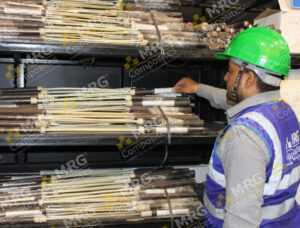

Choosing the right GFRP Rebar manufacturer is not just about finding the lowest price. The quality of the bars matters just as much. Differences in fibre content, resin quality, curing and tensile strength can affect how the reinforcement performs in a concrete structure over time.
So, how do you know which manufacturer you can trust?
Before placing an order, look beyond the product specifications. Check the manufacturer’s certifications, quality control process, test reports, production capacity and delivery commitments.
In this guide, we cover the key factors to consider when choosing a GFRP Rebar manufacturer, what to look for when comparing product quality and prices, and which documents to request before buying. You’ll also find a practical checklist to help you evaluate suppliers and make a confident decision.
Check BIS Certification and Compliance with Indian Standards
A manufacturer’s BIS certification is one of the 1st things to check when choosing a GFRP Rebar supplier. It helps you confirm whether the product meets the requirements of the applicable Indian Standard.
For GFRP Rebar, check whether the manufacturer holds a valid BIS licence under IS 18256:2023. Don’t rely only on a “BIS Certified” claim on a website or brochure. Verify the licence details before placing an order.
Here are five things to check:
- Licence number: Make sure the number matches across the certificate, website and quotation.
- Company name: The legal company name on the licence should match the company invoicing and supplying the bars.
- Applicable standard: Confirm that the licence covers GFRP Rebar under IS 18256:2023.
- Approved sizes: Check whether the licence covers the bar sizes required for your project.
- Licence validity: Make sure the BIS licence is currently valid.
You can verify the details through the official BIS website or ask the manufacturer for a copy of its licence.
Our BIS Certification
MRG Composites India Private Limited holds BIS licence CM/L-7600217414 for GFRP Rebar under IS 18256:2023. You can visit our BIS-certified GFRP Rebar page to check our certificate details.
One important point: BIS certification confirms compliance with the applicable product standard. It does not automatically mean that every bar size is suitable for every project. Your structural engineer must still verify the selected bars against the project’s design requirements. For road, highway and bridge projects, also consider the relevant Indian Roads Congress guidelines and project specifications.
Evaluate GFRP Rebar Quality and Testing Reports
A BIS licence confirms that the manufacturer is certified to produce GFRP Rebar under the required standard. A product test report shows how a specific batch of bars performed during testing. Ask the manufacturer for both documents.
Check whether the test results meet the requirements of IS 18256:2023, using the test methods specified in IS 18255:2023.
Here are some key requirements to check:
| Property | IS 18256:2023 requirement |
| Glass fibre content | At least 75% |
| Glass transition temperature | At least 100°C |
| Degree of cure | At least 95% |
| Mean tensile modulus | At least 45 GPa |
| Mean ultimate tensile strain | At least 1.1% |
| Ultimate tensile force | Must meet the guaranteed value for the bar size |
| Transverse shear strength | At least 130 MPa |
| Bond strength | At least 7.6 MPa |
| Moisture absorption (24 hours) | No more than 0.25% |
| Tensile force after alkaline exposure (90 days at 60°C) | At least 80% of the original value |
| Tensile force of 90° bent bars | At least 60% of the guaranteed force for straight bars |
At MRG Composites, we test GFRP Rebar in our in-house laboratory at different stages of production. Our tests cover tensile strength, tensile modulus, fibre content, bond strength and bar dimensions. We also check each production batch before dispatch.
What should you check in a test report?
- Measured cross-sectional area: Check the measured area of each bar size, not just its nominal diameter.
- Guaranteed and mean values: Check both values. Guaranteed values provide a more conservative measure of the bar’s performance.
- Testing laboratory and date: Check where and when the tests were carried out. Independent laboratory reports can provide additional confidence.
- Batch number: Make sure the report matches the batch you are purchasing.
- Creep and fatigue results: Ask for these test results if your project involves long-term loads or repeated loading.
Don’t judge GFRP Rebar by tensile strength alone. Fibre content, stiffness, bond strength and durability also affect how the bars perform in concrete.
Check the GFRP Rebar Manufacturer’s Production Process and Capacity
Good test results matter, but a GFRP Rebar manufacturer must maintain the same quality across every production lot. IS 18256 requires manufacturers to document their production process and maintain consistency in materials and production methods within each lot.
Ask the GFRP Rebar supplier:
- Which glass fibre and resin types they use. The standard permits E-CR or R glass and vinylester or epoxy resins. Polyester is not permitted in the base polymer.
- How often they check fibre content, resin curing and bar dimensions during production.
- How each production lot is identified and tested before dispatch.
- Whether they repeat product qualification tests when materials, processes or bar sizes change. The standard requires this and calls for testing at least every three years.
- How they plan production for large orders, and what the realistic lead time is.
- Whether the plant follows safety and air-quality practices for working with glass fibre, as required by the standard.
If possible, visit the plant or request photos and a video walkthrough. Avoid relying on GFRP Rebar production capacity claims that the supplier cannot back with documents or a site visit.
Check Available Sizes, Specifications and Customisation Options
IS 18256:2023 specifies nine standard GFRP Rebar sizes, ranging from G4 (4 mm) to G32 (32 mm). However, manufacturers may not stock or produce all sizes.
Ask the supplier which sizes are readily available, made to order or available only on special request. Get confirmation in writing for every size listed in your bar schedule.
Confirm these points:
- Size list: Which standard sizes are available now, and which are made to order.
- Lengths: Cut lengths and how bars are bundled. The standard allows bars up to 12 mm to ship in coils or straight lengths, and larger bars in bundles of 8 m or 12 m.
- Surface enhancement: Sand-coated, ribbed or other, as this affects bond.
- Factory-bent GFRP bars : GFRP bars cannot be bent on site, so stirrups and hooks must be made at the factory. Ask for the minimum bend radius by size and how bent bar strength is tested.
- Custom shapes: Ask how bends, diameters and leg lengths are specified in the order, and how long custom work adds to lead time.
- Size marking: Bars should be marked with the size designation and minimum guaranteed tensile force, so you can check what arrives on site.
Selecting the right size for a design is an engineering decision. Your structural engineer should set diameter and spacing, and the supplier’s data should confirm the bar’s certified properties for that size. See our GFRP composite rebar page for MRG’s product range.
Review Previous Projects and Manufacturing Experience
Experience shows up in project history. Ask for named projects with enough detail to verify them, and look at whether the supplier has handled work like yours.
Useful signs of relevant experience:
- Named infrastructure or industrial projects with location and application, such as roads, bridges, drainage, flooring or marine works.
- Which bar sizes and types were supplied, including straight and factory-bent bars.
- Quantities supplied and delivery timelines.
- Contact details for a contractor or engineer who can confirm the supply.
- Photographs of installation and test records tied to the project.
Check how long the manufacturer has been making GFRP bars, and whether its experience matches your application. You can review our GFRP Rebar project case studies to see examples of our work across different applications.
If a supplier claims to have completed many projects but cannot provide references, ask for proof before trusting the claim.
Compare Pricing, Delivery Time and Bulk Order Support
A quoted price per kilogram is only comparable when everything else in the quotation matches. Before a bulk order, line up these items across suppliers:
| Item | What to confirm |
| Sizes and quantities | Exact designations (G8, G12 and so on), quantity per size and cut lengths |
| Price basis | Per kg or per metre, stated clearly, for the same size and surface type |
| Taxes | GST and any other applicable charges, shown separately |
| Transport and delivery | Who pays, delivery point, and unloading arrangements |
| Customisation | Extra charges for bent bars or special lengths |
| Packaging | UV-resistant wrap and bundle protection, as required for storage and transit |
| Lead time | Production time per size, plus dispatch time, tied to your site schedule |
| Payment terms | Advance, milestone and credit terms |
| Documentation | MTC and test reports included with each lot |
Keep two things in mind when comparing GFRP Rebar prices.
The lowest price may mean lower fibre content, poor curing or no batch testing. So, compare quality documents along with the price.
Also, GFRP Rebar and steel require different bar sizes and quantities. Comparing only the price per kg can give a misleading result. Always compare costs based on your project requirements.
For bulk GFRP rebar orders, contact MRG Composites with your bar schedule to discuss pricing, production planning and delivery timelines.
Check Product Documentation and Batch Traceability
Good documentation helps you verify the GFRP Rebar you purchased, even months after delivery. IS 18256:2023 includes traceability requirements, so ask the manufacturer for these documents and details with every lot:
- Manufacturer’s Test Certificate (MTC): The standard requires an MTC for each lot, including the lot number and test results. Make sure it is included in your purchase order.
- Product test reports: Ask for test results covering the properties required by the standard and linked to the relevant lot.
- Bar marking: Each bar should carry the manufacturer’s name or brand, size designation and minimum guaranteed tensile force at intervals of two metres.
- Bundle or coil tags: Check that each tag shows the manufacturer, bar size, guaranteed tensile force, lot number and production month and year.
- Technical datasheet: Ask for product properties and instructions for handling and storage.
- Handling and storage guidance: GFRP Rebar should be kept off the ground and protected from sunlight and abrasion. Use suitable cutting methods instead of shearing.
Also ask what happens if a lot fails quality checks. IS 18256:2023 requires non-compliant production lots or consignments to be rejected. The supplier should explain how replacements and disputes are handled.
Supplier Checklist and Questions to Ask Before Placing an Order
Use this table to score two or three suppliers side by side. Fill the last two columns as you collect documents.
| Evaluation factor | What to verify | Supplier A | Supplier B |
| BIS certification | Valid licence for IS 18256:2023, matching name, number, sizes and validity | ||
| Product quality | Test reports against IS 18256:2023 limits, linked to a lot | ||
| Manufacturing | Actual facility, process control and lot testing | ||
| Product range | Required sizes, lengths and bent shapes, with made-to-order items marked | ||
| Project experience | Named, verifiable references for similar work | ||
| Bulk supply | Production capacity and delivery commitments in writing | ||
| Documentation | MTC, test reports, marking and batch details with each lot | ||
| Technical support | Datasheets, handling guidance and a named contact for queries |
Before you confirm an order, ask the supplier these questions:
- Can you share the BIS licence number and certificate, and which sizes does it cover?
- Can I see a recent test report for the exact sizes I need, with the lot number?
- Which bars on my schedule are standard stock and which are made to order?
- Will each lot ship with a Manufacturer’s Test Certificate?
- What is the lead time per size, and what happens if production slips?
- How are bent bars made and tested, and when do you need my final bar bending schedule?
- What is your process if a delivered lot fails inspection?
- Can you name a project where you supplied similar bars?
Why Consider MRG Composites for Your GFRP Rebar Requirements?
MRG Composites has manufactured and supplied GFRP rebar since 2019. We hold BIS licence CM/L-7600217414 for IS 18256:2023, and MRG Composites India Pvt Ltd is listed among the organisations on the BIS working group that formulated the standards for FRP bars. You can read more about MRG Composites and our team.
At MRG Composites, we follow the same checks. We share product specifications, test reports and certification details. We also clarify which GFRP Rebar sizes are readily available and which are made to order. Your structural engineer makes the final product selection based on your project requirements.