
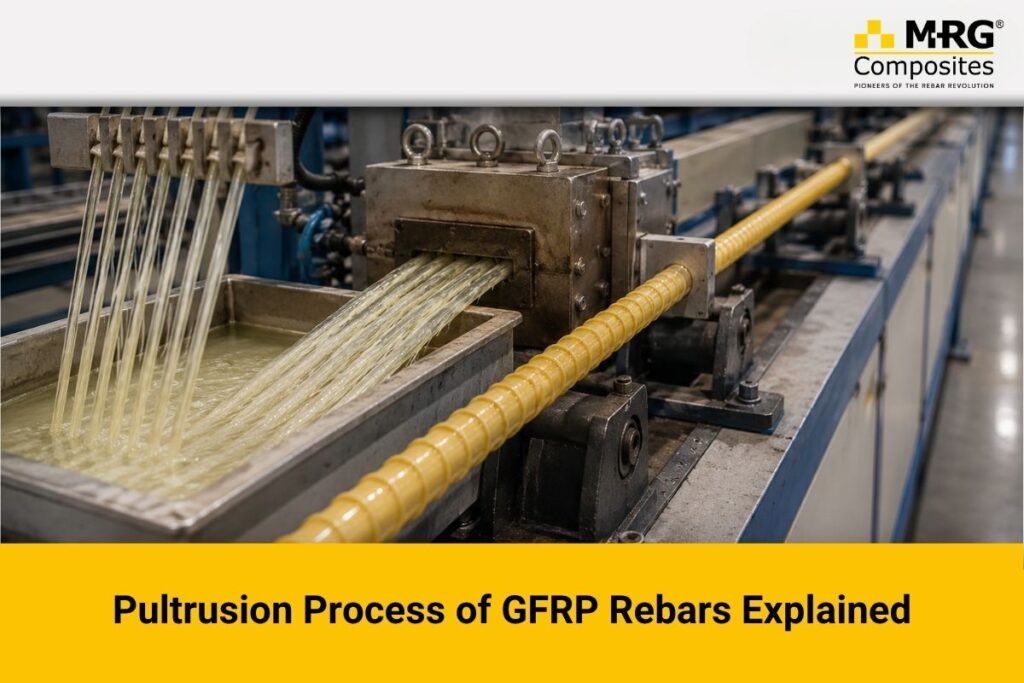
GFRP Rebar does not start as a finished reinforcement bar. It is built continuously from glass fibers and a polymer resin through a manufacturing process called pultrusion.
During pultrusion, continuous glass fibers are aligned, impregnated with resin, shaped into a bar, cured, given its required surface profile, and cut to length. The process needs close control because fiber alignment, resin distribution, curing, dimensions, and surface finish all affect the quality of the finished reinforcement.
This guide explains how GFRP Rebar is manufactured through pultrusion and what happens at each stage.
At MRG Composites, every GFRP Rebar we manufacture goes through this same controlled pultrusion process — the reason we’re able to offer consistent quality as one of the leading GFRP Rebar manufacturers in India.
What is the Pultrusion Process?
Pultrusion is a continuous process used to make composite products with a consistent shape. Instead of pushing the material through a die, the fibers are pulled through the production line.
For GFRP Rebar, continuous glass fibers are fed into the line and saturated with resin. The fibers then pass through forming guides and a heated die, where the resin cures and the bar takes shape. Once cured, the bar continues through the line before being cooled and cut to the required length.
The basic idea is simple:
Glass fibers + resin + controlled forming + curing = continuous GFRP Rebar
However, each stage needs to work correctly for the finished bar to meet its required dimensions and performance.
What Materials Are Used to Make GFRP Rebar?
The two main components are continuous glass fibers and a polymer resin matrix.
Continuous Glass Fibers
Glass fibers provide the primary reinforcement within the composite. They are supplied as continuous rovings and arranged along the length of the bar.
Their alignment is important because the GFRP Rebar is designed to carry tensile forces primarily along its longitudinal direction.
Polymer Resin
The resin surrounds the glass fibers and forms the matrix that holds them together. It also transfers stresses between the fibers and protects the reinforcement from its surrounding environment.
Different resin systems provide different characteristics, so the resin selection needs to match the intended application and manufacturing requirements.
The fiber and resin do not work independently. The final properties of the GFRP bar depend on how well the fibers are aligned, impregnated, consolidated, and cured within the matrix.
How is GFRP Rebar Manufactured?
The pultrusion line can be viewed as a continuous sequence rather than a series of completely separate operations.
Step 1: Glass Fiber Feeding and Alignment
The process starts with continuous glass fiber rovings stored on creels or spools.
The fibers are pulled from these spools and guided toward the production line. Guide plates and tension-control systems help keep the fibers properly positioned as they move forward.
This stage matters because inconsistent fiber alignment can affect the distribution of reinforcement within the finished bar.
The goal is to create a stable, continuous fiber package before it enters the resin system.
Step 2: Resin Impregnation
The aligned glass fibers then pass through a resin system where the resin penetrates the fiber bundle.
This stage is often called wet-out.
Complete impregnation is important because the resin needs to surround the fibers and form a continuous matrix around them. The production system also controls the amount of resin carried forward with the fibers.
The resin system can contain the base resin along with other materials used to achieve the required manufacturing and product characteristics.
Rather than simply “coating” the fibers, the objective is to properly impregnate the reinforcement before it reaches the forming and curing stages.
Step 3: Preforming the Fiber Bundle
After resin impregnation, the wet fiber package passes through a series of guides or preforming elements.
The material gradually moves toward the required round bar profile.
Preforming helps:
- Organize the fibers
- Remove excess resin
- Establish the approximate bar shape
- Prepare the material for the final die
- Reduce the risk of fiber displacement
This stage is important because the fibers need to enter the final forming die in a controlled arrangement.
A poorly controlled preforming stage could contribute to uneven fiber distribution, voids, or dimensional inconsistencies.
Step 4: Forming and Curing in the Heated Die
The preformed material then enters a heated forming die.
This is where the resin changes from a liquid or partially reacted state into a hardened polymer matrix.
The die performs two jobs at the same time:
- It establishes the required cross-sectional dimensions.
- It provides the controlled heat needed for curing.
Temperature, pulling speed, resin formulation, and die conditions need to remain within the manufacturer’s process parameters.
The result is a continuous, rigid composite bar with a controlled shape.
This is one of the most important stages of the entire pultrusion process because incomplete or inconsistent curing could affect the finished product.
Step 5: Developing the Rebar Surface
A GFRP Rebar needs more than a correctly formed core. Its surface also needs to provide suitable interaction with concrete.
Depending on the product design, manufacturers use surface treatments such as sand coating, helical wrapping, or other approved surface profiles to improve mechanical interaction with concrete.
The surface treatment is therefore not simply for appearance.
It is part of the reinforcement’s functional design.
The exact surface configuration depends on the product and manufacturing process, so the finished bar should be evaluated against the applicable product requirements.
Step 6: Pulling the Cured Bar
Once the material has passed through the curing stage and developed sufficient rigidity, a pulling system continuously moves the bar through the production line.
Pultrusion systems use different pulling arrangements, including continuous caterpillar-type systems and reciprocating systems. The basic principle remains the same: the material is pulled through the line rather than pushed through it.
Consistent pulling is important because changes in production speed can influence the relationship between the material and curing conditions.
Step 7: Cooling and Cutting
After leaving the heated die, the finished bar moves through the remaining production line and cools before cutting.
An automated cutting system then produces bars at the required lengths.
The continuous nature of pultrusion allows manufacturers to produce long lengths of GFRP reinforcement and then cut them according to product or project requirements.

Looking for a Quality GFRP Rebar?
What Controls the Quality of Pultruded GFRP Rebar?
Quality control starts with the raw materials and continues through to the finished GFRP bar. Manufacturers typically check:
- Fiber quality and alignment – Proper alignment helps maintain consistent reinforcement quality.
- Resin properties and impregnation – The fibers need to be properly saturated with resin to form a consistent matrix.
- Resin-to-fiber ratio – This needs to stay within the manufacturer’s specified range.
- Process temperature and pulling speed – These affect curing, dimensional stability, and how long the material remains in the forming and curing stages.
- Bar dimensions and surface condition – These are checked to make sure the bars are consistent and suitable for use with concrete.
- Mechanical performance – The finished bars are tested against the requirements of the applicable product standard.
For structural reinforcement, these checks should follow a recognized specification. For example, ASTM D7957 covers solid round GFRP bars used as concrete reinforcement. The exact tests and acceptance criteria depend on the standard being followed.
Why Do Fiber Alignment and Surface Treatment Matter?
Fiber alignment and surface treatment both affect how GFRP Rebar performs in concrete. During pultrusion, continuous glass fibers are kept aligned along the length of the bar to provide longitudinal strength. The bar surface is also treated, such as with sand coating or helical wrapping, to improve its bond with concrete.
Together, these manufacturing steps help the finished GFRP bar provide the required strength and grip inside concrete.
Need GFRP Rebar for Your Project?
Choose GFRP reinforcement manufactured for demanding concrete applications. Talk to MRG Composites about your project requirements, bar sizes, and reinforcement needs.
Common Manufacturing Issues in GFRP Pultrusion
Even though pultrusion is a continuous process, several production issues need to be controlled.
| Issue | What It Affects |
| Uneven fiber distribution | Variation within the composite |
| Incomplete resin impregnation | Fiber bundle inadequately surrounded by resin |
| Excess resin | Fiber-to-resin balance and production consistency |
| Incorrect curing | Resin curing (from wrong temperature or speed) |
| Dimensional variation | Finished bar diameter or profile |
| Surface defects | Consistency of the reinforcing surface |
Good process control catches these issues before they affect large quantities of finished product.
Pultrusion Process vs. Steel Rebar Manufacturing
GFRP Rebar and steel rebar use different manufacturing processes. Steel rebar is made through steelmaking and rolling, while GFRP Rebar is a composite made from continuous glass fibers held together by a polymer resin matrix.
This difference starts at manufacturing and continues into design and installation.
| GFRP Rebar | Steel Rebar |
| Composite material | Metallic material |
| Glass fibers provide reinforcement | Steel provides reinforcement |
| Polymer resin forms the matrix | Steel forms the structural material |
| Produced through pultrusion | Commonly produced through steel rolling processes |
| Surface profile developed as part of composite manufacturing | Ribbed profile formed during steel production |
| Lightweight composite reinforcement | Heavier metallic reinforcement |
Because GFRP Rebar is a composite material, its manufacturing process needs to be designed around the properties of glass fibers and resin.
From Glass Fiber to Finished GFRP Rebar
The complete process can be summarized as:
Glass fiber feed → Fiber alignment → Resin impregnation → Preforming → Heated die forming and curing → Surface treatment → Pulling → Cooling → Cutting → Quality inspection
Each stage contributes to the finished reinforcement.
The fibers provide the primary longitudinal reinforcement. The resin forms the surrounding matrix. The die establishes the bar shape. The curing stage hardens the composite. The surface treatment prepares the bar for interaction with concrete. Finally, cutting and inspection prepare the product for delivery and use.
Frequently Asked Questions
Final Thoughts
The pultrusion process is what turns continuous glass fibers and polymer resin into a consistent GFRP reinforcement bar.
But the process is more than feeding fibers into a machine and curing them. Fiber alignment, resin impregnation, preforming, die conditions, curing, surface development, pulling speed, and final inspection all contribute to the quality of the finished bar.
Understanding these stages gives engineers, contractors, and buyers a better idea of what goes into manufacturing GFRP Rebar and why controlled production matters when the finished product is used as structural concrete reinforcement.
Want to know more about MRG Composites’ manufacturing standards or get a quote for your project? Contact us →