
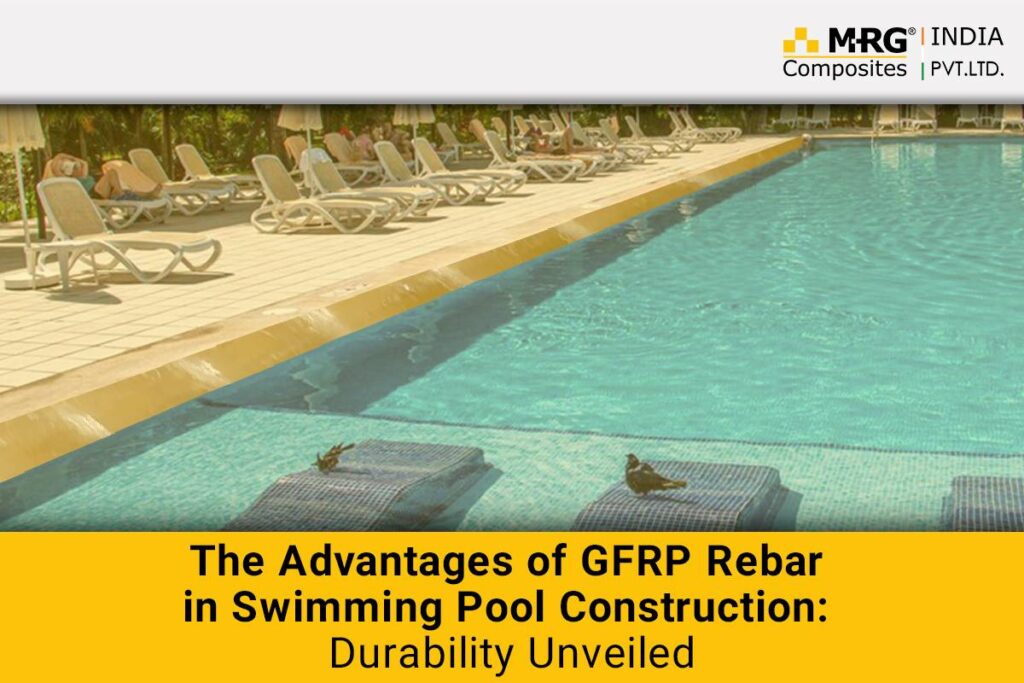
The Advantages of GFRP Rebar in Swimming Pool Construction: Durability Unveiled
Corrosion resistance and durability are essential for swimming pool construction. Swimming pool construction needs construction materials that can handle water and chemicals. Steel rebar is not compatible with water; using steel rebar in swimming pool construction requires regular maintenance. GFRP Rebar is a corrosion-resistant construction material. It is compatible with water. By using GFRP Rebar, we can minimize the construction and maintenance costs.
MRG Composites is a leading GFRP Rebar manufacturers in India, and supplies worldwide. With experience of more than 18+ years, we have successfully completed 5000+ projects. MRG GFRP Rebars are more stronger, lighter, corrosion-resistant, durable, conductive, and cost-effective construction material.
Why Swimming Pools Need GFRP Rebar
Every pool builder knows that water finds its way through even the best concrete. When it reaches steel bars, corrosion starts from within. Rust expands over time and starts cracking the concrete. It weakens the shell. GFRP Rebar is compatible with water, so it can solve this issue. It does not react with chlorinated or saltwater and ensures the pool shell remains intact for decades.
The constant moisture, pressure, and chemical exposure inside a swimming pool create a harsh environment for steel. GFRP remains unaffected in these conditions. It offers peace of mind to both contractors and clients — once installed, it doesn’t corrode or require maintenance.
On-Site Efficiency: How GFRP Simplifies Pool Construction
Swimming pool Contractors need to take care of various things such as cost, labor charges, construction material, design, and construction.
- Lighter: GFRP Rebar is ¼ lighter than traditional steel rebar. It is easy to transport and install. It saves the transportation costs.
- Stronger: GFRP Rebar is 2 times stronger than traditional steel rebar. It makes the swimming pool construction stronger.
- Corrosion resistant: GFRP Rebar is compatible with water, salt water, and chemicals, so it is an ideal choice for swimming pool construction
- Durable: GFRP Rebar increases the life span of swimming pool construction. It is a durable construction material.
- Thermal stability. Pools experience temperature differences between concrete and water, especially in outdoor or heated pools. Steel tends to expand or contract, creating micro-cracks over time. GFRP’s low thermal conductivity minimizes this risk, keeping the concrete structure stable.
- non-corrosive nature means surfaces stay clean and crack-free over time, preserving the design integrity of luxury pools and resorts.
Technical Comparison: GFRP vs. Steel Rebar
| Property | GFRP Rebar | Steel Rebar |
| Corrosion Resistance | Fully corrosion-proof | Susceptible to rust in moisture and chlorine |
| Weight | 75% lighter | Heavy and hard to handle |
| Tensile Strength | 2x stronger | Standard strength |
| Thermal Conductivity | Very low | High, causes cracking |
| Magnetism | Non-magnetic | Magnetic |
| Durable | Yes | No |
| Maintenance | None | Requires protective coatings or repairs |
GFRP Rebar is far better than traditional steel rebar. You can check the in-depth GFRP Rebar vs. Steel rebar.
Practical Applications in Swimming Pool Construction
Pending from here
GFRP rebar can be used across all key structural elements of a pool:
- Pool Shells and Walls: To resist hydrostatic pressure and prevent cracking.
- Pool Decks and Coping Areas: To eliminate rust stains caused by moisture.
- Retaining Walls and Overflow Channels: To maintain long-term strength against water and chemical exposure.
- Infinity Edges and Decorative Designs: To allow thin-section construction without corrosion risk.
Contractor can cut GFRP Rebar as per their requirement which allows to make custom custom-designed swimming pool.
Long-Term Value and ROI
Switching to GFRP may seem like a premium choice initially, but the long-term value outweighs the cost difference. Traditional steel pools often require repairs after 5–7 years due to corrosion. GFRP structures, in contrast, can last for decades without intervention.
Owners save on repair, repainting, and resurfacing costs. Contractors save on warranty claims. Engineers and architects gain credibility by delivering long-lasting projects. In the long run, GFRP rebar provides a higher return on investment (ROI) and peace of mind for everyone involved.
GFRP Rebar is a bit premium. By using GFRP Rebar, a Swimming pool does not require regular maintenance or replacement. It saves the maintenance and swimming pool construction
Sustainability and Modern Construction Standards
Modern construction is not just about strength — it’s about sustainability and lifecycle performance. GFRP rebar supports both. Its lightweight design reduces fuel usage during transportation. Its long lifespan reduces waste generation from frequent repairs.
By aligning with green building practices and durability codes such as ACI 440 and FIB standards, GFRP rebar positions itself as the reinforcement of the future for water-retaining and chloride-exposed structures.
Conclusion
For swimming pool contractors, engineers, and architects, GFRP rebar offers a rare combination of strength, longevity, and design freedom. It eliminates the core problem of corrosion, simplifies construction, and delivers sustainable value. In an industry where quality and reputation depend on long-term results, GFRP stands out as the smarter, future-ready alternative to steel.
Pools built with GFRP rebar stay stronger, cleaner, and safer — for decades. That’s not just an upgrade; it’s a transformation in how we build for water, durability, and design excellence.