
Lighter Loads, Stronger Structures: GFRP Rebar’s Bridge Benefits
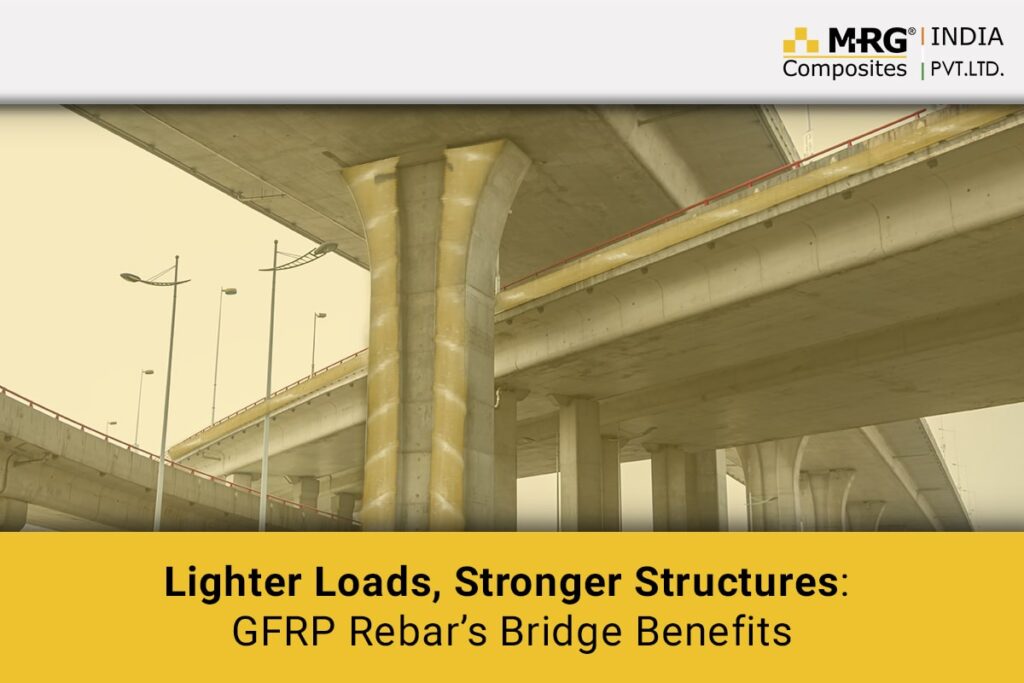
One of the biggest challenges in bridge construction is lightweight. Traditional steel rebar are more heavier. It increases the bridge construction weight. GFRP Rebar – Glass Fiber Reinforced Polymer Rebar is ¼ lighter than traditional steel reinforcement bars. GFRP Rebar is lighter yet provides more strength to bridge construction.
MRG Composites
MRG Composites is a leading GFRP Rebar manufacturers in India. MRG GFRP bars are stronger, lighter, corrosion-resistant, and cost-effective bridge construction material. MRG Composites has completed 5000+ projects in last 17 years.
Why Lightweight Reinforcement Matters in Bridges
Bridges carry heavy traffic loads day after day. Reducing the dead load — the weight of the structure itself — is one of the easiest and most effective ways to increase lifespan and safety.
Here’s why lightweight materials play a crucial role:
- Lower self-weight reduces stress on piers, beams, and foundations.
- Construction becomes simpler, requiring fewer machinery resources.
- Seismic performance improves because lighter elements respond better to vibrations.
- Material handling becomes faster, saving labor time and increasing productivity.
This is where GFRP Rebar stands out.
GFRP Rebar: The Lightweight Advantage That Changes Everything
The most defining property of GFRP Rebar is its weight, roughly 1/4 the weight of steel. This single attribute creates a cascading list of advantages for bridge designers, contractors, and maintenance teams.
Below are the key lightweight-driven benefits.
1. Easy Handling and Faster Construction
Because GFRP Rebars are far lighter than steel, workers can carry, cut, and install them without heavy equipment.
How the lightweight property helps:
- Manual handling becomes easier and safer.
- Placement time has reduced significantly.
- Fewer workers are needed on site.
- No cranes or lifting equipment required for rebar placement.
This efficiency often accelerates construction timelines, especially for large bridge decks and precast elements.
2. Lower Dead Load = Stronger, More Efficient Bridges
Dead load reduction is one of the biggest engineering objectives. GFRP Rebar contributes to lighter components, such as:
- Bridge decks
- Girders
- Precast slabs
- Parapet walls
Impact of reduced weight:
- Increased structural capacity
- Reduced foundation requirements
- Enhanced fatigue performance
- Better long-term stability
A lighter bridge doesn’t mean a weaker bridge — it means a more optimized one.
3. Enhanced Seismic Safety
Seismic forces act on structures proportional to their mass. Lighter reinforcement minimizes displacement and improves resilience during earthquakes.
Advantages for seismic zones:
- Reduced inertia forces
- Lower risk of cracking
- Better energy dissipation
- Improved post-quake serviceability
This is why GFRP is widely preferred in coastal and earthquake-prone regions.
4. Reduced Transportation and Installation Costs
Transporting steel rebar for large bridge projects is expensive due to weight limitations. GFRP Rebar changes the economics.
Cost advantages:
- More material can be transported per trip
- Lower fuel costs during shipping
- No need for heavy-lifting cranes
- Reduced labor hours during installation
Contractors often see noticeable savings across the project lifecycle.
5. Compatibility with Precast Bridge Elements
Precast manufacturers benefit greatly from lightweight reinforcement. GFRP Rebar helps produce lighter precast components that are easier to move, lift, and assemble on-site.
Benefits for precast applications:
- Faster production cycles
- Reduced risk of cracking while lifting
- Lower transportation weight
- Smooth installation on bridge sites
This makes GFRP ideal for precast beams, barriers, approach slabs, and deck panels.
6. Lightweight but Strong: High Strength-to-Weight Ratio
Despite being light, GFRP Rebars give extremely high tensile strength — often higher than steel.
Strength-driven benefits:
- High load-carrying capacity
- Excellent resistance to fatigue
- Less risk of brittle failure
- Stable performance over decades
This strength-to-weight ratio is one of the main reasons engineers are shifting to GFRP.
7. No Corrosion = No Extra Weight from Protective Systems
Traditional steel reinforcement needs coatings, corrosion-resistant alloys, or protection systems — all of which add weight.
GFRP removes this problem entirely.
Lightweight durability benefits:
- No rusting or oxide formation
- No additional protective layers
- Reduced maintenance load on bridges
- Longer structural life
This is especially valuable for coastal bridges, marine structures, and salt-exposed highways.
8. More Design Flexibility for Engineers
With GFRP’s lightweight nature, engineers have the freedom to design innovative bridge layouts without worrying about excess dead load.
Design advantages:
- Broader span possibilities
- Slimmer structural elements
- Better architectural freedom
- Optimized reinforcement ratios
This flexibility helps build bridges that are not just safe but also aesthetically advanced.
9. Long-Term Performance with Minimum Upkeep
Less weight and zero corrosion together reduce the long-term maintenance burden.
Lifecycle benefits:
- Fewer repairs over the decades
- Reduced traffic disturbances
- Lower lifecycle costs
- Improved sustainability
For authorities managing large transport networks, this becomes a major advantage.
Conclusion: Lightweight GFRP Rebars Are Shaping the Future of Bridge Construction
Across modern bridge projects, the need for lighter, stronger, and more durable structures is growing. GFRP Rebars deliver exactly that — a reinforcement option that cuts dead load dramatically while improving performance, ease of handling, and long-term reliability.
By focusing on weight reduction, GFRP Rebars help engineers build:
- Safer bridges
- More economical structures
- Longer-lasting infrastructure
- Faster and more efficient construction processes
For any bridge project looking to combine lightweight construction with superior structural strength, GFRP Rebar is no longer an alternative — it’s the new preferred standard.